
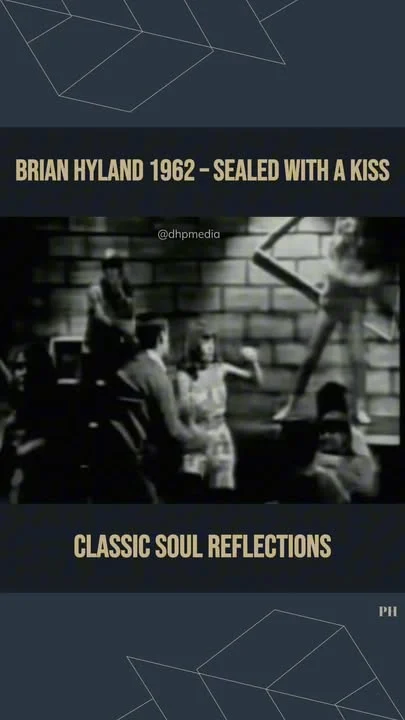
It is a late summer evening, decades removed from 1962, and the melody drifts through the open window like a ghost. Somewhere, a young man is learning the chords on an old acoustic guitar, trying to capture a feeling his words cannot reach. He is facing his first real separation, and the song that fills the room is Brian Hyland’s quiet masterpiece Sealed With A Kiss. The emotion settles over him like a fog, and for a moment, the distance between a Brooklyn teenager and a modern heartbreak collapses into nothing. This is not just a pop song from a bygone era. It is an anthem of longing that refuses to age.
Hyland had come a long way from the novelty of Itsy Bitsy Teenie Weenie Yellow Polkadot Bikini, the 1960 hit that made him a household name. By 1962, he had signed with ABC-Paramount and found his true voice under the songwriting duo Gary Geld and Peter Udell. Their collaboration produced a string of richer, more vulnerable singles, but none matched the aching purity of the title track from Hyland’s 1962 album. The song was a deliberate departure, a chance for a nineteen-year-old idol to prove he could carry more than a catchy chorus. He did not sing of eternal loss. He sang of a long summer apart, a promise to meet again in September. That simple anchor held the entire emotional weight of the record.
The arrangement itself was a lesson in restraint and intimacy. The rhythm section, driven by George Duvivier’s steady bass and Gary Chester’s light drums, provided a soft foundation. Gary Geld’s piano carried the melody, delicate and precise, sometimes doubling Hyland’s vocal, sometimes offering a shimmering counterpoint. Hyland reportedly recalled that Geld based the melody on a Bach finger exercise, a hint of classical simplicity beneath the pop surface. The guitar work of Mundell Lowe and Al Caiola was subtle, almost a whisper, while Blackie Shackner’s harmonica became the song’s signature. It evoked the sound of a train pulling away, the loneliness of distance. The production, guided by Stan Applebaum, was clean and spacious, allowing Hyland’s clear tenor to occupy the center of every moment.
Hyland delivers the central promise not as a defiant claim but as a whispered plea for survival.
The dynamic arc of the recording is what gives it such power. In the verse, Hyland’s voice is nearly spoken, sincere and understated. Then the chorus swells. The drums push forward, and a gentle wordless harmony enters like a breath. The harmonica solo that follows is a simple mournful cry, carrying the weight of the lonely summer the singer anticipates. It is a small emotional crescendo that mirrors the heart’s own surge of memory. The song never overreaches. It stays quiet, intimate, as if the singer is leaning close to the microphone to share a secret.
This was a crucial moment for Hyland. It bridged the gap between the novelty of his earlier work and the deeper emotional territory that the coming rock era would demand. The record climbed high on both the US and UK charts, a testament to its universal reach. But its true legacy lies in its ability to speak across time. It is a song for any forced absence, for a soldier stationed far from home, for a teenager at summer camp, for anyone who has ever held a letter and imagined a kiss sealed in ink. Today, the medium has changed, but the melancholy remains identical. It is a quiet vow against the noise of separation.
Hyland’s transformation from a bright novelty act to a serious ballad singer was complete. He had captured the delicate, enduring power of a promise kept. The song remains one of the finest transitions from summer to autumn ever recorded, a perfect capsule of anticipation and regret. It reminds us that heartbreak is not always loud. Sometimes it is just a long, cold wait, rendered in the voice of a Brooklyn boy who learned to sing the ache of waiting.