
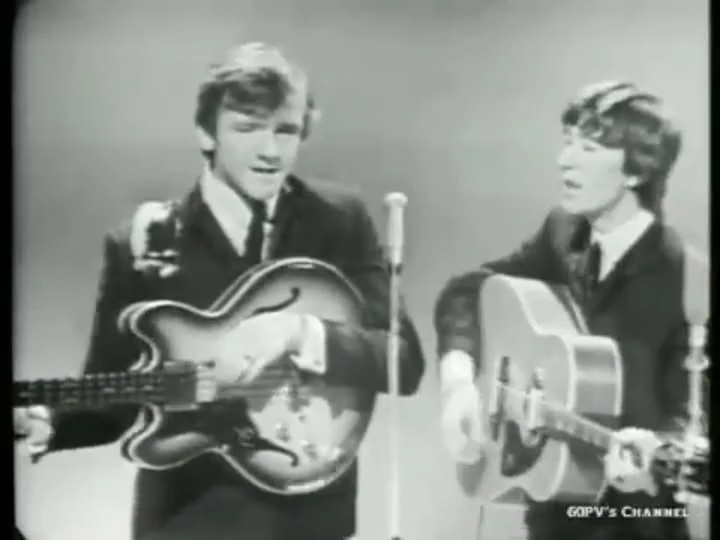
Herman’s Hermits had a rare gift for making the world feel lighter. In 1965, while their British Invasion peers chased sonic rebellion and studio experimentation, this Manchester quintet chose a different path. They crafted pop music so clean and radiant it sliced through the cultural static like a beam of pure sunshine. The song that best captures that magic is “Can’t You Hear My Heartbeat,” a two-and-a-half-minute firecracker that still detonates with joy.
The memory arrives with startling clarity. An old, beat-up car rumbling down a rain-slicked highway, grey skies pressing down, the future feeling uncertain. Then, through the radio static, the opening notes burst forth. In an instant, the world transformed. The car felt less rusty, the sky less heavy, the road ahead less daunting. That is the power this song holds. It does not ask for reflection. It simply demands a smile.
The best pop music of this era didn’t just capture a moment. It distilled a feeling into an immediately repeatable burst of sonic sunshine.
The song’s journey to prominence was anything but straightforward. In the United Kingdom, it was relegated to B-side status, a throwaway track on the flip side of a single. But across the Atlantic, it became a juggernaut, climbing high into the Billboard Hot 100 and anchoring the band’s US release, the appropriately titled Their Second Album! Herman’s Hermits on Tour. It was a defining moment in the career of a group that became stateside royalty, the sweethearts of the invasion.
At the center of it all stood Peter Noone, perpetually boyish and impossibly sincere. His voice carried a slight nasal quality, pure and full of wonder, radiating an innocence that felt almost radical in its honesty. When he sang about walking down a highway and hearing those figurative wedding bells, there was no irony, no detachment. It was a vision of romance as uncomplicated as a schoolyard crush, delivered with the earnestness of youth.
Behind the scenes, producer Mickie Most was the master architect. His signature sound was trebly, punchy, and ruthlessly focused on the hook. Songwriters John Carter and Ken Lewis supplied the material, and their composition is a study in pop economy. The track gallops forward with relentless momentum, a musical sprint that mirrors the racing heart of its narrator.
The rhythm section provides the engine. Drums are tight, miked close, and mixed high, driving the pulse with near-mechanical precision. The bass lines are simple and supportive, locked firmly in place without muddying the higher frequencies. But it is the guitar work that gives the song its signature glint. Clean and bright, free from distortion, the lead lines chime and shimmer, doubling with a secondary rhythm guitar on the off-beats. There is no bluesy swagger here, only crystalline melodies that dance around Noone’s vocals with elegant restraint.
Perhaps the most subtle and effective element is the piano. Tucked into the background, it offers a light, almost ragtimey counterpoint that enriches the harmony without ever stealing the spotlight. It was a conscious choice by Most, a way to sweeten the mix for maximum radio penetration. This is not the soulful, pounding piano of the R&B scene. It is an efficient, bright splash of color that elevates the entire arrangement.
The song’s dynamic arc is remarkably consistent. The energy is set high from the first downbeat and never wavers. This sustained exuberance is its greatest strength and the key to its enduring appeal. It captures a feeling of pure, unadulterated happiness, a stark contrast to the increasingly cynical tone that would dominate popular music later in the decade. In its own quiet way, its relentless cheerfulness is subversive, a rebellion against the expected rock posturing.
For modern listeners with quality audio equipment, Most’s production holds up exceptionally well. You can hear the individual attacks on the guitar strings, the subtle compression on Noone’s vocals, the engineered brightness that made the song leap out of transistor radios in 1965. The clarity is remarkable, a testament to the care invested in its creation.
Listen closely, and you will discover delightful imperfections. There is a brief, slightly awkward pause right before the final verse, a moment of almost naive vulnerability that humanizes the otherwise polished production. It is a small detail, but it offers a glimpse of the genuine enthusiasm behind the performance. For aspiring guitarists taking lessons, the melodic lead lines provide a masterclass in economy, proving that sometimes the fewest notes deliver the loudest message.
The song’s legacy extends far beyond its chart performance. It became a template for a certain strain of British Invasion success, demonstrating that well-crafted, American-style pop songs could be delivered with a light British accent and an innocent image. It established Herman’s Hermits as master pop craftsmen, even as other bands pushed the boundaries of the album format.
For those who find themselves captivated by this irresistible track, several other gems from the same era deserve attention. The Turtles with Happy Together shares that same relentlessly upbeat mood and crystal-clear arrangement. The Box Tops with The Letter delivers a similarly short, punchy burst built on an inescapable melody. The Grass Roots with Let’s Live for Today offers a comparable blend of British influence and American pop sensibility. The Four Seasons with Rag Doll uses vocal innocence and rapid tempo to capture excitement. And Gerry and the Pacemakers with Ferry Cross the Mersey, while a ballad, carries that same charming Mop Top-era sincerity.
The lasting quality of “Can’t You Hear My Heartbeat” lies not in complexity but in perfectly executed ambition. Its goal was to be the cheeriest, most irresistible song on the radio, and it succeeded beyond measure. Listening now, the beat remains vibrant and untroubled, a testament to the power of a perfectly crafted pop moment. Turn it up. Let the sunshine back in.