
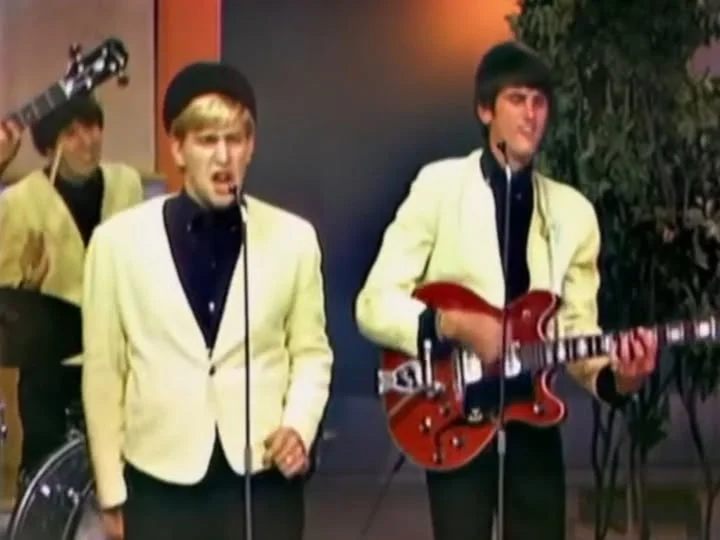
It was a cold, slick night in Portland, the rain falling like a curtain over a city unaware it was about to witness the birth of chaos. April 6, 1963. Inside a converted movie theater that housed Northwestern Inc. recording studio, a group of young musicians calling themselves The Kingsmen huddled together for a rushed, low-budget session. Their goal was humble: a demo tape for a cruise ship gig. What they produced was a two-minute-twenty-four-second burst of primal noise—a record that would become one of the most covered, censured, and beloved pieces of music in rock history: “Louie Louie.”
This was no precision-engineered pop single from the Brill Building’s sophisticated assembly line. It was the raw sound of a garage band, captured in a single, frantic take. Lead vocalist Jack Ely, still adjusting to his recently installed dental braces, strained on tiptoes to reach a boom mic dangling high above. The acoustic bleed, the blurred pronunciation, the sense of barely-contained mayhem—these weren’t mistakes. They were the essence of the track, and they became its legend.
Released locally on Jerden Records, the single was soon picked up by Wand Records for national distribution later that year. It climbed to number two on the Billboard Hot 100, transforming from a regional success into a national phenomenon. No official album welcomed it at first—that came later with The Kingsmen in Person, a hurried compilation that misleadingly added crowd noise overdubs to simulate a live atmosphere. But the song itself needed no embellishment. It was already perfect in its imperfection.
“The whole arrangement feels like a runaway train, perpetually on the verge of derailing, yet somehow always snapping back to that immutable riff.”
The immediate appeal of “Louie Louie” lies in its glorious, almost confrontational simplicity. The track is built entirely on a three-chord progression written by R&B composer Richard Berry in 1957—I-IV-v-IV, or A-D-Em-D in The Kingsmen’s key. This sequence is the bedrock of countless rock songs, but The Kingsmen stripped it back to its rawest, most energetic core. Drummer Lynn Easton set a frantic, nearly collapsing pace, his cymbal crashes sounding less like punctuation and more like sudden explosions. The rhythm section, completed by Bob Nordby on bass, locked into a hypnotic, swinging churn. It was a runaway train, always on the verge of derailing, yet always snapping back to that immutable riff.
The instrumental texture came from the interplay between Mike Mitchell’s slashing guitar work and Don Gallucci’s insistent keyboard part. Mitchell’s guitar tone was cheap, trebly, and utterly compelling—all downstrokes and garage grit, providing the song’s signature melodic hook. The solo itself was a marvel of unrefined urgency: a quick two-bar descent, punctuated by a shouted command, “Okay, let’s give it to ’em right now!” That unplanned moment of chaos defined the proto-punk attitude. Gallucci’s role on the piano was subtle but crucial, providing the organ-like wash that filled the sonic space and gave the record its moody, surf-noir atmosphere.
The production, handled locally by Ken Chase and Jerry Dennon, was the antithesis of polished pop. The drum sound was distant and cavernous; the vocals were distorted and rushed. It was a perfect sonic snapshot of a hurried, live-in-the-room moment. Audiophiles debated its merits, but for the rest of us, it was essential. It sounded like freedom, like a party you weren’t meant to hear. Even today, played through a quality premium audio system, the recording offers a textural depth that modern, overly compressed tracks often lack, highlighting its revolutionary grit.
No discussion of this recording is complete without addressing the legendary vocal track. Ely’s slurred delivery was partly the result of recording conditions and partly an attempt to approximate the style of a previous cover. Crucially, the band’s confusion about the lyrics, combined with the low fidelity, birthed the song’s most enduring myth: that the track contained obscenities. This innocent piece of music became a cultural hot potato. The FBI actually launched an investigation into the purported “smutty” nature of the lyrics, spending two years trying to decipher Ely’s growled words. Their conclusion? The lyrics were simply “unintelligible.” The controversy, of course, only cemented the song’s reputation as a subversive anthem for youth culture—a secret code passed between teenagers, unknowable and defiant to the adult world.
The influence of “Louie Louie” is impossible to overstate. It is proto-punk in its ethos: sloppy, loud, and driven by a need for immediate, cathartic release. It inspired countless high school bands to pick up a cheap guitar and realize they didn’t need virtuosity to make rock and roll—they just needed three chords and conviction. For a kid taking guitar lessons in the early ’70s, this riff was the first great lesson in attitude. It taught them that the mistake could be the magic. The legacy of this recording is not in its professional sheen but in its democratic spirit. It is the ultimate party record, endlessly adaptable, a rite of passage. Over six decades later, putting on The Kingsmen’s 1963 single is not a historical exercise; it is an invitation to a garage session where everything is loud, fast, and gloriously out of control. It remains the perfect anthem for anyone who has ever felt misunderstood.
Listening Recommendations
- “P.S. I Love You” – The Beatles (1962): A sharp contrast in sound, demonstrating the cleaner, tighter rock-pop production dominating the charts at the time of “Louie Louie.”
- “Farmer John” – The Premiers (1964): Another raw, shouted garage classic recorded in a rough, live style that followed the Kingsmen’s template.
- “Dirty Water” – The Standells (1966): Epitomizes the second wave of American garage rock, maintaining raw texture with a slightly more sinister, psychedelic edge.
- “96 Tears” – ? and the Mysterians (1966): Features an iconic, simple organ riff driving the song’s frantic energy and proto-punk sound.
- “Hang On Sloopy” – The McCoys (1965): Uses a similarly simple, driving riff and amateur enthusiasm to achieve massive mainstream success.
- “Twist and Shout” – The Isley Brothers (1962): A high-energy R&B track where the manic, hoarse vocal delivery captures a sense of exhilarating, barely controlled chaos.