
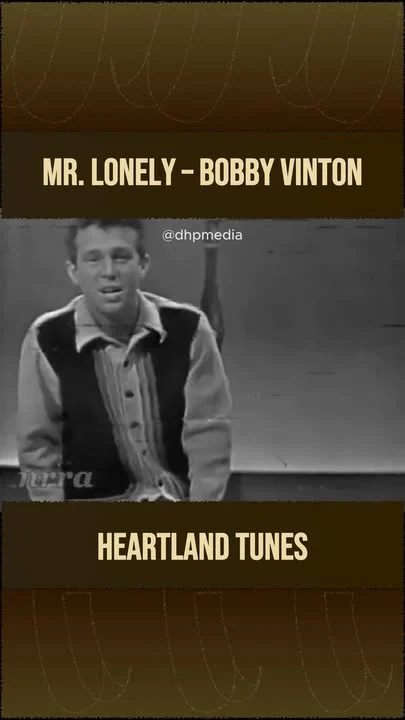
Sixty years have passed since a haunting melody first gave voice to one of humanity’s most private struggles. Yet Bobby Vinton’s “Mr. Lonely” still finds its way into quiet moments, a spectral presence that refuses to fade. It is not merely a song; it is a confession booth for the heart, a mirror held up to the solitude that so many carry yet rarely speak of. The track’s journey from a soldier’s scribbled notes to a global anthem of isolation is a story of persistence, raw emotion, and the uncanny ability of music to articulate what words alone cannot.
The seeds of this classic were planted in the most unlikely of places: the rigid confines of the U.S. Army. Long before he was serenading audiences with “Blue Velvet,” the artist known as the “Polish Prince” was a young man wrestling with a profound sense of displacement. Stationed far from home in an era before instant connection, Vinton channeled the crushing weight of homesickness into a tune that would define his legacy. There were no smartphones, no video calls, only the agonizing wait for a letter that might take weeks to traverse the globe. This experience of being adrift, of being a face in a uniform rather than a son or a friend, became the raw clay for his most personal work.
His initial attempts to share this vulnerability were met with a resounding no from industry executives. The early 1960s was an era powered by the electric energy of rock and roll, a time for danceable hits and youthful exuberance. A ballad that wallowed in heartache was seen as a commercial misstep, a relic of a softer, earlier decade. Yet Vinton was unwavering. He believed in the song’s power, perhaps because it was so deeply intertwined with his own biography. His quiet determination eventually won out, and in 1964, the recording was finally released to the world, arriving at the exact moment a nation divided by conflict needed a voice for its own collective ache.
What strikes a listener first is the breathtaking simplicity of the opening lines.
“Lonely, I’m Mr. Lonely, I have nobody for my own.”
There is no metaphor to untangle, no poetic obfuscation. It is a statement that feels less like a lyric and more like a whispered fact of existence. Vinton doesn’t just sing about sadness; he assumes its identity. He is Mr. Lonely, a personification that makes the emotion feel tangible, a character that lives in the shadows of everyone’s life. This directness is the song’s core strength, allowing it to bypass intellectual analysis and connect directly to our empathetic instincts.
As the verses unfold, they paint a portrait of a man trapped on all sides. There is the physical confinement of being a soldier, a pawn in a larger game he never chose to play.
“I’m a soldier, a lonely soldier, away from home through no wish of my own.”
But more devastating is the emotional quarantine. The subsequent verses speak of letters that never arrive, of being forgotten, of a connection to the outside world that has silently snapped. In an age of constant connectivity, this level of isolation seems almost alien, yet the feeling it evokes is timeless. The despair of sending out words into a void and receiving silence in return is a uniquely modern digital experience, making Vinton’s analog-era sorrow strangely relatable for a generation raised on the internet.
Upon its release, Mr. Lonely did more than just climb the charts; it became a lifeline. At the height of the Vietnam War, its narrative of separation and longing gave a national soundtrack to those separated by conflict. For soldiers in the jungle and families waiting by the mailbox, the song was a shared language of pain. It climbed the Billboard Hot 100 to claim the number one spot, not just as a hit, but as a necessary act of catharsis. The world was hungry for an acknowledgment of its quiet suffering, and Vinton provided it with a gentle, mournful voice.
Musically, the track is a masterclass in the power of restraint. Where other productions of the era were loud and brash, Mr. Lonely relies on a sparse, melancholic arrangement that places the vocal front and center. The tender orchestration creates a hush, a space of reverence that allows Vinton’s voice to ache. There is no vocal acrobatics, only a sincere, vulnerable delivery. He embodies the lyric so completely that the listener is invited to feel as though they are eavesdropping on a private moment of despair, making the experience intensely personal for all who hear it.
The legacy of this ballad extends far beyond its original release. It has proven to be a cultural chameleon, finding new life in different contexts. In 2005, rapper Akon introduced the melody to a new generation by sampling it for his own hit, “Lonely,” proving that the core sentiment remained as potent as ever. Beyond the charts, the track has found a permanent home in film and television, a reliable tool for directors looking to underscore a pivotal scene of heartbreak or character isolation in an instant. It has become a shorthand for a specific kind of sorrow, a sonic cue that speaks louder than any dialogue could.
Perhaps the reason Mr. Lonely refuses to become a mere nostalgia piece is that it is grounded in a truth that remains constant: loneliness is an inevitable part of the human timeline. No one escapes it. It may be triggered by a global conflict, a broken relationship, or a quiet afternoon where the world feels far away, but the feeling is fundamentally the same. Vinton’s refusal to dress this up in metaphor or pretense gives his work a radical honesty. In a music landscape that often prizes polished perfection, this raw vulnerability is a breath of fresh air, a reminder that our most authentic moments are often our most fragile.
In the end, Mr. Lonely is not just a song about being alone. It is a song about being seen. By vocalizing his own deep isolation, Bobby Vinton created a space for millions of others to recognize their own feelings. He transformed a personal memory of military service into a universal message of solidarity. As the final notes fade, the message lingers with a quiet, revolutionary comfort. Even in the deepest throes of our solitude, the existence of this song proves that someone else has felt it too, and in that connection, we find a small, beautiful thread of belonging.