
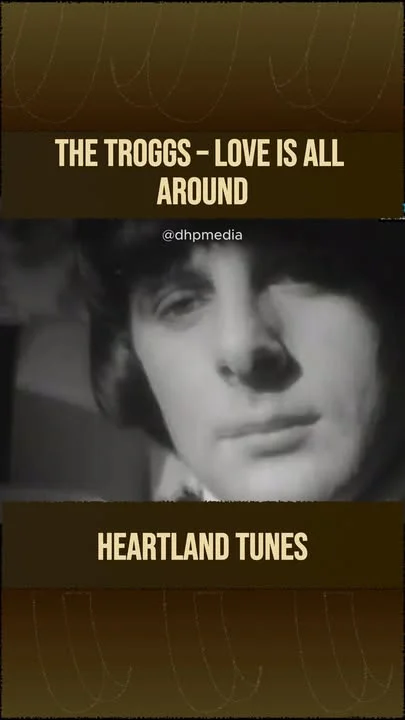
The first time you hear it, those opening lines land like a gentle touch: “I feel it in my fingers, I feel it in my toes.” It’s a confession so simple that it feels almost naive—and yet, more than half a century later, that very simplicity has become the song’s quiet superpower. “Love Is All Around” isn’t just a melody; it’s a held breath, a reminder that the most profound emotions often arrive unadorned.
The band behind this enduring anthem, The Troggs, emerged from Andover, Hampshire, during the roaring mid-60s British Invasion. Known primarily for the raw, garage-rock stomp of “Wild Thing,” they could easily have been written off as a fleeting novelty act. But frontman Reg Presley possessed a gift for capturing the exact pulse of youthful experience—the thrill, the ache, the hope. In his songwriting, he found a way to speak directly to the heart without ever being complicated about it.
By October 1967, the world was still humming from the Summer of Love, a season when peace and unity felt like tangible possibilities. “Love Is All Around” arrived as the perfect soundtrack for that moment—gentle, acoustic-driven, and bathed in warmth. Unlike the brash guitars of earlier Troggs hits, this track leaned on a soft, repetitive melody, subtle string arrangements, and a feeling of intimacy that seemed to invite the listener into a private conversation.
Presley’s lyrics are the song’s quiet revelation. He didn’t reach for metaphors or poetic abstractions. Instead, he let the words feel like a letter written in the middle of the night: “Love is all around me / And so the feeling grows.” There’s a childlike honesty in that repetition—love isn’t something you chase; it’s something you notice, something already there, in the wind, in the face before you on your bed.
I feel it in my fingers, I feel it in my toes
Well, love is all around me
And so the feeling grows
It’s written on the wind, it’s everywhere I go
So if you really love me
Come on and let it show
You know I love you, I always will
My mind’s made up by the way that I feel
There’s no beginning, there’ll be no end
‘Cause on my love you can depend
The song’s immediate success—peaking at number five on the UK Singles Chart—was only the beginning of its journey. Decades later, Wet Wet Wet transformed it into a massive 1994 hit after it was featured in the film Four Weddings and a Funeral. Their version spent an astonishing 15 weeks at number one in the UK, introducing the melody to a generation that had never heard the original. The cover didn’t replace the Troggs’ version; it stood beside it, a bridge between eras, proving that the song’s message required no updates.
What makes a simple phrase like “love is all around” endure across cultural shifts and personal heartbreaks? Perhaps it’s the way the song refuses to over-explain itself. It doesn’t demand that you believe in love or understand it. It simply suggests that you might look for it—in the ordinary, the quiet, the everyday. Whether you’re hearing it for the first time as a teenager or rediscovering it years later, it still lands with the same weight of recognition.
More than 50 years after its release, “Love Is All Around” continues to appear in films, commercials, and wedding playlists, always carrying that same gentle assurance. It’s become a kind of musical inheritance—a reminder that in times of division or doubt, the feeling of being held by something larger than yourself can be as simple as a line you once hummed. The Troggs left behind not just a song, but a quiet argument for joy, one that still feels fresh every time the melody begins.