
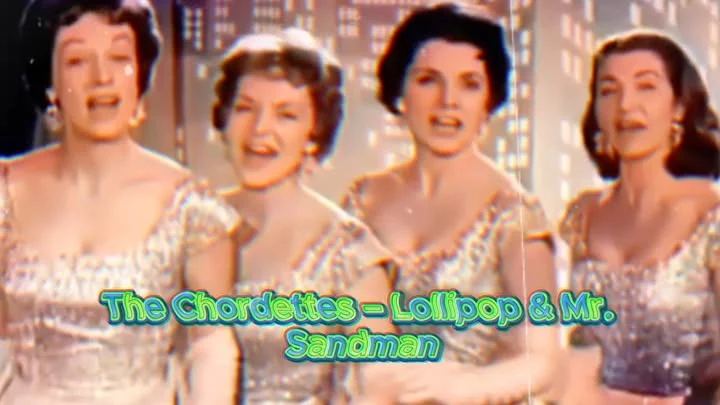
Imagine capturing the sound of an entire decade in a single moment the feather light touch of harmonies that seem to hang in the air like dust motes in sunlight. For countless listeners that moment arrives with the first notes of a Chordettes record. Two songs in particular have become the definitive audio postcards from mid century America: Mr Sandman from 1954 and Lollipop from 1958. Though they began as separate singles on Cadence Records modern fans usually encounter them back to back on anthologies such as The Chordettes Best or Greatest Hits collections where the pair sit side by side. Hearing them sequenced this way reveals something essential about the quartet a perfect fusion of sugar and dream.
The Chordettes formed in Wisconsin drawing on barbershop tradition and traditional pop. Their sound was an airy yet exacting blend a velvet glove around a metronome. Tight enough to lock over a simple rhythm section flexible enough to wink and sway. That balance between virtuosity and warmth was key to their mainstream success and it remains the secret behind these two performances. Producer Archie Bleyer who founded Cadence Records left his fingerprints all over both sides with uncluttered textures disciplined tempos and memorable studio flourishes that never overwhelmed the voices.
Mr Sandman floats on a melody by Pat Ballard that seems to drift of its own accord. The Chordettes meet it with a gossamer four part blend bright and balanced built with architectural precision. Bleyer added a famously intimate touch he kept time by patting his knees giving the track a gentle human click that no snare could replicate. A brief spoken interjection his voice asking a genial Yes punctures the fourth wall without breaking the spell. Pianist Moe Wechsler contributed nimble fills and a cheeky allusion to Liberace complete with a glissando flourish grounded the song in its pop culture moment. The result is a studio miniature two minutes that twinkle like a snow globe. Commercially it was a phenomenon topping multiple Billboard charts in 1954 and 1955 and later earning induction into the Grammy Hall of Fame. Its ascent helped codify a template for female vocal groups crisp diction choral balance and arrangements that let personality peek through in asides rather than vocal runs.
Four years later Lollipop arrived. The song had first been recorded by the teenage duo Ronald and Ruby but The Chordettes cover became the definitive version. From its first seconds the rhythmic handclaps and signature pop effect created by flicking a finger from the cheek turned the chorus into an instantly recognizable hook. A male chorus added punchy boom boom responses giving the record a call and response momentum that felt like a street corner performance. Bleyer again conducted the orchestra keeping textures light and parts tidy so the ear candy never turned saccharine. The single blasted to number two on Billboard s pop chart and number three on the R&B Best Sellers list in 1958 reaching the UK Top 10 as well. That cross format success was telling. While Lollipop had novelty frosting its rhythmic chassis was sturdy the backbeat claps and pop consonants acted as extra percussion while bass and rhythm guitar laid down a dance ready grid. It was a masterclass in making a light song feel kinetic. The syllabic writing with short vowels and crisp plosives gave the arrangement its spring a textbook example for arrangers who want to understand how consonants can be rhythmic instruments.
These records remind us that poise can be thrilling and that the studio can be a stage not for bombast but for intimacy and wit.
The studio colors on both tracks are small yet unforgettable. On Mr Sandman the sonic palette centers on voices piano and a discreet rhythm pulse with orchestrated sweetness never obscuring the lyrics. The novelty touches the knee pat the spoken aside the Liberace glissando are strokes that keep the record alive through repeated listens. On Lollipop the body itself becomes an instrument hands clapping cheeks popping and a male chorus answering like a brass section made of voices. Underneath a compact band of rhythm guitar upright bass and restrained drums keeps time with unshowy professionalism. Neither track depends on instrumental solos they rely on the architecture of entrances exits and textures. You could transcribe both for a cappella group string quartet or high school chorus and keep the essence intact. They are robust designs not just pretty recordings.
The pairing on compilation albums acts like a little thesis on The Chordettes range. Public facing fun on one side private daydream on the other. The interplay reveals both continuity their hallmark blend and diction and contrast in dramatic stance. One track turns the studio into a candy shop the other dims the lights and invites the Sandman in. Experiencing them together gives shape to the group s career beyond the hit single frame. The harmonic DNA from barbershop lineage is obvious tight closed voicings ringing chords lines that move in coordinated blocks. But this is pop trimmed for radio no indulgent tags no extended codas. The rhythm excels at micro groove the tiny subdivisions that make a performance feel buoyant. On Mr Sandman that groove is a tick tock sway from the knee pat and piano accents on Lollipop it is the composite percussion of hands cheeks and bouncing voices. Neither track would benefit from a louder drum kit their grooves live in the air pockets between syllables. The texts are deceptively simple a wish sent to a bedtime deity a confection as a stand in for young love. The Chordettes play both straight with no irony allowing the humor to sparkle without snark.
The cultural afterlife has been generous. Mr Sandman remains a go to sync for scenes that need a retro shimmer its chime instantly recognizable in a single bar. Lollipop thrives anywhere a director wants upbeat wholesome energy with a knowing wink. That longevity is why labels still treat these masters as crown jewels. For aspiring arrangers and producers there is practical homework inside these confections study the balance of voices notice how the novelty sounds in Lollipop are mixed as musical elements not gimmicks notice how Mr Sandman keeps its dream alive with rhythmic clarity rather than reverb haze. These are evergreen lessons as relevant to a modern singer songwriter with an acoustic guitar as to an engineer comping background parts at the piano. The craft here scales it is the rare pop candy that is also nourishing.
So cue up an anthology let the sequencing do its quiet magic. Consider how much personality lives in two minutes when the priorities are blend timing and imagination. Consider too how easily these recordings translate across listening contexts Sunday morning at home a road trip detour into golden age pop or a dedicated deep dive into vocal group arranging. However you file them pop standards oldies vocal jazz adjacent they remain models of how to make a small studio canvas feel big. The best compilations present the songs as a one two punch first the bright candy then the dreamy glide. Taken together they form an ideal introduction to The Chordettes art for modern ears. And they hold up under any kind of listening on vintage vinyl in remastered digital form or tucked into a playlist between country ballads and classical instrumentals. After all any arranger who has wrestled with a sparse chart knows the paradox these records solve so elegantly the fewer the elements the more each detail matters. When the details are this good the whole thing sings.