
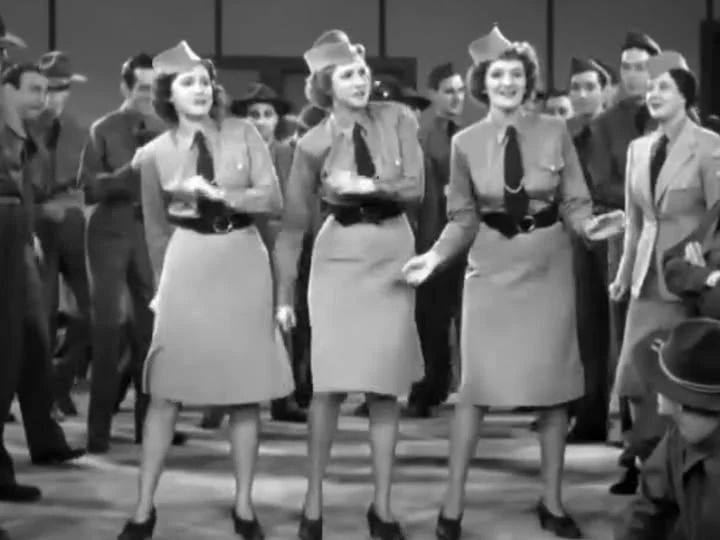
Some records don’t age. They glow. That luminous quality defines Boogie Woogie Bugle Boy, a track that still crackles with energy more than eighty years after its creation. The moment the first notes hit, listeners are transported into a world where voices and instruments fuse into an irresistible force. It is not merely a song but a living artifact of swing era alchemy, a compact story about a horn player drafted into an army band that transcends its wartime origins to become something timeless.
That sound—compact, spirited, and utterly alive—is why the record continues to animate dance floors, playlists, and movie scenes.
The Andrews Sisters introduced this gem in the 1941 Abbott and Costello film Buck Privates, where it served as a Decca single tied to the movie’s promotion. Yet most modern listeners encounter the recording within album contexts, either on soundtrack reissues or anthologies like The Best of the Andrews Sisters. In such compilations, the song becomes a pivot point, showcasing the trio’s close-harmony brilliance while anchoring a narrative that links their pre-war novelties to later, more cosmopolitan hits. An album setting allows the ear to hear the track in the larger arc of their career, revealing its crackle, cleverness, and evolution into cultural memory.
At the heart of the magic lies the triadic blend of Patty, Maxene, and LaVerne Andrews. Their approach is rooted in close harmony, with voices locked into tight intervals that produce a single, luminous sound. Patty typically carries the melodic center while Maxene and LaVerne weave responsive figures, resulting in an athletic yet playful texture. Their meticulous alignment of diction, attack, and vowel shapes gives rapid-fire passages like He was a boogie-woogie bugle boy of Company B their rhythmic precision. Behind them, Vic Schoen and His Orchestra elevates the song from clever ditty to swing juggernaut, with a bristling trumpet line that mimics the bugle’s reveille call and a rhythm section driving boogie-woogie pulse.
The arrangement’s architecture is remarkably economical. It opens with a bugle-like motif, telegraphing the story with a touch of comedy before entering a buoyant verse-chorus cycle. Harmonically, the chart leans on blues-tinged I-IV-V movement common to boogie-woogie, but it never sits still. Turnarounds keep momentum, short brassy hits frame transitions with zing, and sections arrive in brisk 16-bar packets that keep the ear hooked. The band mirrors the syllabic shape of lyrics, creating a symbiosis between words and orchestration where every blow and boogie feels etched by horns, every cadence sealed by the rhythm section. Production values from 1941 also shape the personality, with microphone placement emphasizing the vocal blend at center and the band slightly behind, close enough to converse yet far enough to keep text audible. A touch of room reverb sharpens up-tempo diction rather than blurring it, resulting in a dance record that still works as a narrative performance.
As a wartime artifact, Boogie Woogie Bugle Boy occupies unusual cultural terrain. It is not propaganda but camaraderie, humanizing the soldier-musician as a working artist drafted into a new ensemble. This translation of civilian jazz sensibility into a military context mirrors the broader cultural shift as the United States prepared for conflict. Swing energy became a morale booster, and The Andrews Sisters were among its most charismatic ambassadors. The song’s appearance in Buck Privates widened its audience exponentially, cementing the trio’s Hollywood footprint and the melody’s ubiquity.
People often fixate on the trumpet when discussing the instruments in this recording, understandably, since the story centers on a horn player. But the record’s heartbeat is the rhythm section: the boogie-woogie piano sketching chord tones, the bass walking four-to-the-bar with unerring confidence, the drummer’s cymbal time and snare pops. The reeds deserve recognition too, with saxophones cushioned in midrange harmony, clarinet timbres adding sparkle, and ensemble figures tucking under vocals like a well-tailored suit lining. The brass writing favors compact statements over extended solos, reinforcing pop concision. Vocal texture itself becomes an instrument, as the sisters deploy syllabic scatting not as improvisation but as rhythmic ornaments stitching sections together. Their precision gives the band license to punch harder, and in rare moments where a single voice steps forward, the blend never dissolves. Such ensemble work rewards repeat listening.
Historically, the song has continued to ripple. Bette Midler‘s 1970s cover revived it for a new generation, going Top Ten and proving the arrangement’s structural resilience. Yet the Andrews Sisters’ original remains definitive, largely due to how the vocal blend and big-band chart capture swing’s social DNA—music built for dancing, parties, movie houses, and evenings around the radio. When sequenced among other Buck Privates numbers or in chronological compilations, you hear it framed by the era’s stylistic diversity, each color shaped by changing instrumentation and studio techniques. Albums teach the ear to recognize lineage, situating Bugle Boy alongside Don’t Sit Under the Apple Tree or Rum and Coca-Cola, raising a historical throughline from tight-harmony swing to post-war pop.
One reason the track feels evergreen is its blend of specificity and universality. The lyric narrates one gifted horn player in Company B, but the emotional theme is broader: how artistry finds its outlet even in institutional settings. The bandstand becomes a place of community, musicians pushing and pulling in time, trading riffs, laughing, locking in. For educational purposes, the song is a superb primer on swing-era arranging. Study how the band comments on lyrics, answering phrases, setting up punchlines, cueing transitions. Notice how the rhythm section is always forward, never dragging. Listen to the dynamics: the chart breathes, swelling under choruses, paring back for clarity, surging for climactic tags. For vocal groups, it is a masterclass in blend, vowel unification, and breath control. For horn players, it showcases short-form phrasing where tone and articulation do the heavy lifting.
In the streaming age, it is easy to treat a three-minute classic as sonic wallpaper. But giving Boogie Woogie Bugle Boy an attentive spin on a full compilation or soundtrack pays dividends. Services often group the song within thematic albums, and that context changes how you hear it. A romantic ballad before it makes the boogie feel brighter; a novelty tune after amplifies the trio’s comic timing. Hearing it in album context recreates a bit of the 78-rpm experience, when artists and labels thought carefully about sequence and mood. Because the song has become a universal shorthand for 1940s swing, it retains commercial appeal, rediscovered each decade in vintage-styled ads, film montages, and brand campaigns.
The recording also invites a broader conversation about pop evolution. The trio’s blend, honed on radio and vaudeville stages, prefigures the girl-group sound of the 1960s in its emphasis on tight harmonies and rhythmic lead. The band’s writing, with crisp riffs and sectional interplay, foreshadows horn-driven soul arrangements of later decades. An unbroken thread runs from the jump blues of Bugle Boy to punchy brass hooks in Motown, to horn stabs in modern funk and pop. When you hear how orchestra and voices dance together, you trace a lineage straight to contemporary charts, even when instrumentation shifts to synths and drum machines.
For those exploring swing or revisiting old favorites, make room for this track. It is a lesson in arrangement, a testament to ensemble craft, and a reminder that some records don’t age. They glow. Pair it with a curated swing playlist to appreciate how its rhythms dialogue with the era’s broader sound world. Curators and filmmakers eyeing vintage cues will find that thoughtful licensing of the right master can lend the precise sepia sparkle they seek.
Listening recommendations for similar vibes and historical kin
Don’t Sit Under the Apple Tree (With Anyone Else but Me) by The Andrews Sisters offers another wartime earworm with exemplary close harmony and buoyant swing. Bei Mir Bist Du Schoen earlier but essential, showcases their tone, humor, and effortless blend. In the Mood by Glenn Miller and His Orchestra is the canonical big-band groove, riff-based and infectiously danceable. Chattanooga Choo Choo by Glenn Miller with The Modernaires parallels Bugle Boy with narrative charm and rhythmic buoyancy. Tuxedo Junction by Erskine Hawkins or Glenn Miller provides a slow-burn swing standard with creamy reeds and a walking pulse. Shoo-Shoo Baby by The Andrews Sisters captures their knack for tone color and phrasing. Rum and Coca-Cola post-war and rhythmically different, remains crucial for understanding their stylistic range.
When curating your library, choose editions that retain the transient snap of the drums and gleam of trumpets without over-brightening the vocal. Some reissues aim for vintage warmth; others emphasize detail. Trust your ear. Context enhances the joy, whether you are a learner or a nostalgic listener. The trumpet says reveille, the piano rolls its boogie pattern, the bass strolls in quarter notes, the drums lay down dancing time, the reeds and brass chatter with wit—and three voices fuse into a single, irreplaceable instrument. That is why the record continues to animate dance floors, playlists, and movie scenes eight decades on.