
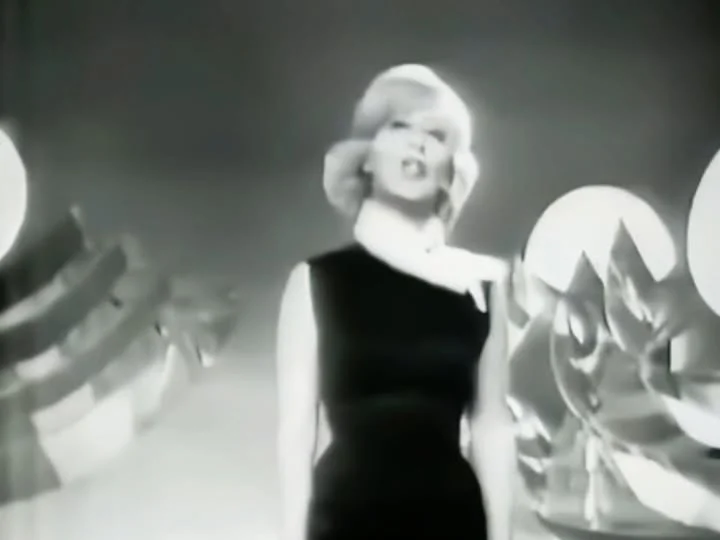
Imagine a rainy motorway late at night. The windscreen wipers beat a steady rhythm against the glass. Then, from the car radio, a voice erupts—clear, brassy, and commanding. It is 1963, and Britain’s pop landscape is shifting. The polished crooners of the post-war years are being pushed aside by the raw energy of Merseybeat. Into this moment steps Kathy Kirby, a stunning blonde with operatic training, managed to evoke the smoky glamour of old Hollywood while aiming straight at teenage hearts. Her breakthrough was not a gentle ballad but a calculated reinvention: the October 1963 release of “Secret Love.”
The song itself was an American standard, an Academy Award winner immortalized by Doris Day in the 1953 film Calamity Jane. Day’s version was a dreamy, reflective waltz—a private confession unfolding in slow cinematic sweeps. Kirby’s recording, produced by Peter Sullivan and directed musically by Charles Blackwell, tore that delicate framework apart and rebuilt it as a three-minute pop rocket. It was a gutsy challenge to a beloved classic. Kirby herself reportedly felt the original could not be topped. But the goal was not to improve it—it was to transpose it entirely. The contemplative mood was jettisoned from the first downbeat. Sullivan and Blackwell, attuned to shifting tastes, began not with the gentle verse but with the climactic middle eight. “Now I shout it from the highest hill” rings out immediately. The secret is already exposed. The catharsis is pre-loaded.
This audacious structural choice was only the beginning. The sound of the record is a study in early 1960s British pop orchestration: lush, but with a surprising edge of grit beneath the glamour. The instrumentation is a hybrid of old-school big band polish and emergent beat-group dynamism. The rhythm section is taut, driving the song at near-breakneck pace. You can hear the close-miked snap of the drums, the insistent thrum of the bass, and a shimmering layer of orchestral strings that provide the essential sheen for the “Golden Girl of Pop.”
Crucially, the track is marked by a distinctive guitar part. The session player was reportedly a young Jimmy Page, years before he would define the sound of rock with Led Zeppelin. His presence adds a bright, almost cheeky energy, weaving quick, clean, syncopated counter-melodies around Kirby’s powerhouse vocal. This is not heavy distortion—it is an articulate electric foil to the orchestral arrangement, a clever nod to the burgeoning beat sound without sacrificing the grand spectacle Kirby represented.
Kirby’s vocal delivery is the centerpiece. She possessed a remarkable instrument, trained for opera. Here, she deploys its power with sophisticated restraint that belies the song’s furious tempo. Her voice is clear, commanding, with a brassy resonance that cuts through dense orchestration without sounding strained. She hits the high notes with open-throated certainty, lending weight and emotional conviction to the joyful, newly public confession of the lyric. It is a dazzling display of controlled strength—a vocalist simultaneously maintaining the poise of a cabaret star and the power of a pop diva.
The arrangement is a masterclass in controlled dynamics. The full-throttle ensemble swells during the chorus, pushing emotional volume to the maximum, then pulls back smartly during the verses. A quick, descending flourish from the piano often acts as a transition point, a sparkling connector between vocal phrases, preventing the relentless speed from becoming monotonous. This dynamic push and pull is what makes the premium audio experience of the track—even on a crackly old 7-inch vinyl—so compelling. It is a fully realized sonic landscape, meticulously layered for maximum impact.
It is a sound that perfectly encapsulates the moment of a confident woman deciding her own fate, throwing open the door to her heart with the sheer force of her voice.
This single cemented Kathy Kirby’s place in the British pop firmament, following her earlier success with “Dance On!”. It peaked at number 4 on the UK charts, becoming her biggest hit and establishing her, for a brief incandescent period, as the leading female voice in British pop. That same year, she won the New Musical Express poll’s “Top British Female Singer” award. Her commercial popularity also boosted her first album, Sixteen Hits from Stars & Garters, a compilation of songs from the popular TV show on which she was a regular. This piece of music became synonymous with her “blonde bombshell” persona, selling millions and dominating the airwaves as the Beatles simultaneously took over the world. Kirby, for all her big-band background, found a way not just to survive the rock era but to momentarily thrive within it, simply by turning up the tempo and the volume.
The track’s lasting appeal lies in that joyous velocity. It is a perfect sonic encapsulation of release—of secrets unburdened, feelings finally shared in the open. It is the sound of a gamble paying off, a traditional standard successfully translated into the modern language of pop. It is a moment of glamour and grit colliding on a Decca 45 RPM single, leaving behind a timeless and energetic record that still begs for a turn on the dance floor.