
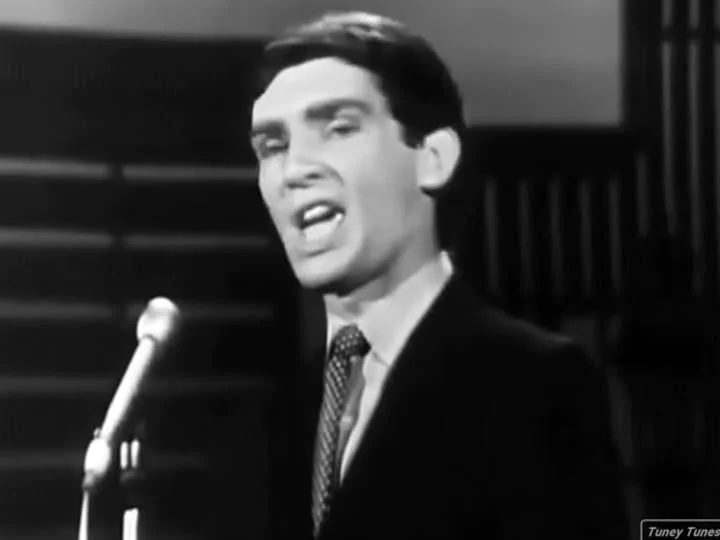
There are moments in music history when a voice transcends its era and speaks directly to the heart across generations. Gene Pitney’s Looking Through The Eyes Of Love is exactly that kind of recording a timeless ballad that still sends shivers down the spine nearly sixty years after its release. When Pitney opened his mouth to sing those first tender notes, he wasn’t just performing a song he was unlocking a doorway into the very soul of romantic longing.
Gene Pitney possessed one of those rare tenor voices that could climb to soaring heights without ever losing its warmth. By 1965, when he released the album Looking Through The Eyes Of Love, he had already proven himself a master of emotional storytelling. This particular collection cemented his reputation as a vocalist who could weave country sincerity with pop sophistication and orchestral grandeur into something that felt both intimate and cinematic.
The album itself is a treasure chest of contrasts upbeat numbers sitting comfortably beside heart-wrenching ballads but the title track remains its crowning jewel. It is the kind of composition that stops you mid-step and demands your full attention.
What makes Looking Through The Eyes Of Love so enduring begins with its orchestration. The arrangement is a delicate balancing act where every instrument knows its place. A gentle piano melody opens the piece like the first light of dawn before guitar strums weave a warm, rhythmic foundation underneath. Then come the strings a full section that swells and recedes like waves of emotion, giving the track a cinematic quality that rivals the great film scores of the 1960s. The percussion stays restrained, brush strokes on snares and soft drum beats that never overpower the voice at the center of it all.
And that voice. Pitney’s performance is a masterclass in controlled vulnerability. He sings of seeing the world through the lens of love with an earnestness that makes the lyrics feel less like poetry and more like confession. The song was penned by Barry Mann and Cynthia Weil, two songwriting giants whose words could have felt generic in lesser hands. But Pitney transformed them into something deeply personal as if he had lived every syllable.
The production is polished yet retains an organic feel, allowing Pitney’s voice to shine.
In an era when rock ‘n’ roll was shaking the foundations of popular music and folk movements were rewriting the rules of storytelling, this track stood apart for its sheer sophistication. It refused to shout for attention. Instead, it invited listeners in with quiet confidence, blending country authenticity with classical elegance in a way that feels almost effortless. Even today, in a world of auto-tuned pop and algorithmic playlists, this ballad resonates with anyone who still believes in the power of a well-crafted love song.
For those who find themselves moved by Pitney’s masterpiece, there are other treasures waiting to be discovered. Roy Orbison’s Crying shares that same soaring vocal drama and lush instrumentation. Elvis Presley’s Can’t Help Falling in Love offers a similar orchestral warmth. The Righteous Brothers’ Unchained Melody matches the sweeping string arrangements and emotional depth. Patsy Cline’s Crazy brings the country-infused heartache that Pitney himself often channeled. And Neil Sedaka’s ballad version of Breaking Up Is Hard to Do proves that even familiar songs can be reborn through orchestral reinvention.
The album Looking Through The Eyes Of Love stands as a testament to Pitney’s artistry, a collection that captures a moment when pop music dared to be both grand and vulnerable. But it is the title track that lingers longest in memory. From the delicate piano phrases that introduce the song to the sweeping string crescendos and Pitney’s unforgettable tenor rising above it all, every element works in perfect harmony.
This is not merely a nostalgic artifact. It is a living piece of musical history that feels just as moving today as it did when it first spun on turntables in 1965. For anyone searching for a song that captures the very essence of romantic orchestral pop, Looking Through The Eyes Of Love deserves a place at the very top of your playlist.