
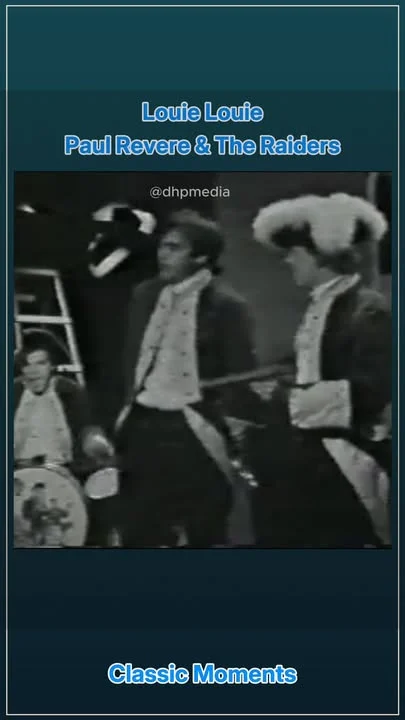
For a moment, set aside the tricorn hats and the technicolor pop art. Forget the carefully coiffed hair of Mark Lindsay and the madcap keyboard antics of Paul Revere. The true birth of this American phenomenon lies in a soggy Portland spring of 1963, inside a low‑budget studio where a regional band tried to capture lightning in a bottle. The song was “Louie Louie” and the band was Paul Revere and the Raiders. Their version remains the forgotten counterpunch to the champion, a hard‑edged, hungry record that almost changed rock history.
Rewind to the Northwest Recorders studio in Portland. The Raiders had just cut a raw, no‑frills take of Richard Berry’s calypso‑infused R&B number. Producer Roger Hart captured the band live in the room, with none of the slick polish that would later define their hits under Terry Melcher. This is the sound of a relentless touring unit, not yet the television darlings of Where the Action Is. It is garage rock in its truest form, energetic and flawed, driven by a dense rhythm section and the insistent churn of the lead guitar.
The track opens with an immediate kick drum, propulsive and commanding. Paul Revere’s electric piano and organ blend into a warm, low‑end drone, providing a bedrock over which the other instruments chatter. It lacks the sharp attack of their later Columbia recordings, giving it a distinctly “live” feel. Mark Lindsay’s vocal is surprisingly clean and urgent, a clear‑eyed sailor pouring his heart to a bartender named Louie. This clarity was likely its commercial undoing. The rival version by The Kingsmen, with its notoriously garbled lyrics, sparked rumors and an FBI investigation, turning accidental mumbling into a cultural phenomenon that money could not buy.
The instrumental break is a riot of noise—a short sax solo that bleeds into a distorted, squalling guitar riff. The whole arrangement is loud, compressed, and slightly muddy, a hallmark of budget‑conscious regional rock recordings of the early 1960s. This is not the polished sound of a premium audio system. It is the sound of a band shoving every ounce of their energy onto magnetic tape before fame arrived.
Paul Revere and the Raiders released “Louie Louie” as a single on the Sande label, later picked up by Columbia Records. It became a regional smash, reportedly hitting number one in the West, but its national chart range remained minor. Many sources note that Columbia A&R man Mitch Miller, no fan of rock and roll, curtailed the single’s national promotion. That decision inadvertently cleared the runway for The Kingsmen, whose version became a flashpoint. Imagine a world where the Raiders’ tauter, clearer arrangement had been allowed its full run. They might have arrived as stars before Dick Clark’s Where the Action Is launched hits like “Kicks” and “Hungry” into the national consciousness. But the universe chose chaos.
For the modern listener, this version serves as a reminder that rock and roll success is often a lottery of circumstance. It is garage rock in its purest form, a short sharp shock of R&B aggression filtered through the white kids of the Pacific Northwest. When teaching the fundamentals of the garage sound, this track is the perfect exhibit A for urgency over polish. It teaches economy, attack, and commitment. It is the genesis point, the moment Paul Revere and his Raiders transitioned from a successful regional band to a group with undeniable, though initially suppressed, potential for national stardom.
The raw energy of “Louie Louie” connects to the modern listener by stripping away decades of artifice. Put it on a quiet night and let the unpolished attack of the drums and the driving rhythm force your attention. It is a track that demands movement, even as you appreciate its crucial near‑miss placement in the history books. For those who want to explore further, here are five essential companion tracks that capture the same spirit of Northwest garage aggression and regional rock grit.
The Kingsmen – “Louie Louie” – The indispensable, messy, and legendary rival version, famous for its garbled vocal track and cultural impact.
The Wailers – “Louie Louie” (with Rockin’ Robin Roberts) – An even earlier foundational Northwest version that bridges Richard Berry’s R&B original with the frantic garage sound.
The Sonics – “Strychnine” – For a similar, absolutely ferocious Northwest garage-punk aggression and raw, overdriven instrumentation.
The Standells – “Dirty Water” – Shares the same thick, driving rhythm and gritty regional rock atmosphere of early 1960s American garage bands.
The Monkees – “I’m Not Your Steppin’ Stone” – A later, slicker, Terry Melcher‑produced garage‑pop hit that illustrates the Raiders’ sound after they achieved national stardom.