
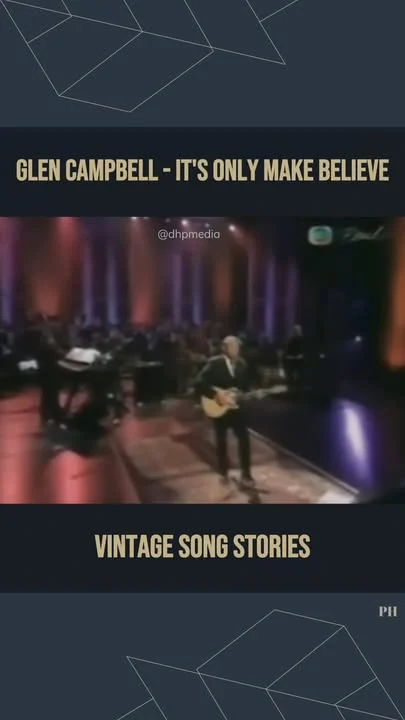
There is a particular kind of magic that happens when a song is reborn—when an artist takes a familiar melody and bends it into something entirely new, something that feels like it was always meant to exist in this tender, aching form. Such is the case with Glen Campbell’s remarkable 1969 interpretation of “It’s Only Make Believe,” a recording that transforms a frantic rockabilly plea into a masterpiece of quiet devastation.
The room grows still as the needle finds its groove. A single piano chord hangs suspended in the air, dripping with reverb, and for a moment, time itself seems to pause. The strings enter not with force but with a gentle, almost sorrowful embrace. This is not the music of a man shouting his pain to the heavens; this is the sound of someone whispering their deepest wounds into the darkness, hoping no one but the night itself might hear.
What makes this recording so extraordinary is not just the artistry on display, but the radical transformation it represents. The original song, written and performed by Conway Twitty in 1958, was a wild, nearly manic explosion of youthful energy—a rockabilly number that seemed to sweat and shout with desperate urgency. Twitty’s version was raw, unpolished, and utterly compelling in its straightforward passion. But Campbell, working with the legendary producer Al De Lory, saw something different lurking beneath the surface of those lyrics.
By 1969, Glen Campbell had already established himself as one of the most versatile and sophisticated voices in American music. He was the man who could bridge the gap between Nashville’s country heart and Los Angeles’s polished session scene, a figure comfortable enough to hold his own with the legendary Wrecking Crew while maintaining the down-home authenticity that made him a television star. His recordings of Jimmy Webb classics like “By the Time I Get to Phoenix” and “Wichita Lineman” had already set a new standard for what country music could achieve in the hands of a master interpreter.
“His recording transforms the song from a desperate plea into a sophisticated, aching confession.”
The arrangement that Campbell and De Lory crafted for “It’s Only Make Believe” is nothing short of architectural genius. The strings do not assault the listener; they support and surround the vocal performance like a protective cocoon. The rhythm section operates with barely a whisper—the brushed drums and graceful bass lines provide a foundation that never draws attention to itself, allowing the emotional weight of the performance to take center stage.
Campbell’s vocal delivery here represents a masterclass in restraint. Where Twitty had roared, Campbell sighs. Where the original had pushed forward with manic energy, this version pulls back, creating space for contemplation. Listen carefully to how he handles the central lyric: “My heart cries out for you / But that’s only make believe.” The slight, almost imperceptible hesitation before those final words reveals everything—it is the sound of a man catching himself just before the final emotional plunge, desperately clinging to the last shreds of dignity.
The recording technique itself deserves appreciation. Campbell’s voice is close-mic’d, creating an intimacy that feels almost uncomfortable in its proximity. You can hear the subtle breaths, the careful control of each note as it leaves his lips. This is not the distant, echo-laden vocal of a stadium performer; this is the sound of someone sitting across from you in a dimly lit room, confessing their most private failures.
What emerges from this careful production is a song that speaks to the private performances we all must give. It is about the smile we wear when our hearts are breaking, the confidence we project when we feel most vulnerable, the elaborate act we stage for the world while our inner lives remain silently devoted to something just beyond our reach. Campbell’s persona—the wholesome farm boy who somehow managed to become a television star and session musician—lent an inherent sincerity to this high-gloss production. When he sings about loneliness, you believe that even a man with gold records and a hit TV show knows the hollow ache of pretending.
The track’s enduring power lies in its refusal to give in to the easy emotional payoff. The dynamics build slowly, like a tide rolling in rather than a wave crashing against the shore. The strings swell at the chorus, but they do so with a deep, soft surge that feels almost reluctant. This arrangement understands a fundamental truth: true emotional weight often comes from what we choose to hold back, not from what we release.
This version of “It’s Only Make Believe” did not merely chart; it defined a moment in musical history when genre boundaries began to dissolve. Campbell brought country’s emotional honesty to pop’s sonic ambition, creating recordings that felt equally at home on a jukebox in Bakersfield or a console stereo in Manhattan. The song invited—demanded, even—an intimate re-listening, stripping away decades of familiarity to reveal the exquisite, fragile structure beneath the surface.
For those who wish to explore this rich vein of late-night heartbreak and sophisticated production, the following recordings share the same sonic DNA and emotional landscape:
Bobby Goldsboro – “Honey” (1968): A lush, melancholy masterpiece of Countrypolitan arrangement, exploring similar themes of sentimental regret with the same orchestral expansiveness.
Ray Price – “For the Good Times” (1970): Another country artist whose orchestral arrangements defined the sophisticated sound of late-night heartbreak, proving that emotional authenticity and polished production could coexist beautifully.
Frank Sinatra – “It Was a Very Good Year” (1966): The Chairman of the Board demonstrates the same masterful use of dynamic control and string texture to convey deep, adult reflection and the weight of memory.
The Association – “Never My Love” (1967): A perfect example of West Coast pop’s seamless vocal delivery and complex arrangement work, where every element serves the emotional narrative.
Jim Reeves – “He’ll Have to Go” (1959): The quiet, intimate baritone style that bridged traditional country with smoother, more polished sounds, creating a template for the emotional vulnerability that Campbell would perfect.
Skeeter Davis – “The End of the World” (1962): A devastating exercise in close-mic’d vocals and soaring orchestration, proving that sometimes the most personal stories told with the most careful production become the most universal.
In the end, Campbell’s “It’s Only Make Believe” remains not just a cover, but a definitive statement on the transformative power of musical interpretation. It stands as the gold standard for how to completely reimagine an established classic—not by trying to outshine the original, but by trading volume for vulnerability, speed for stillness, and desperation for dignity.