
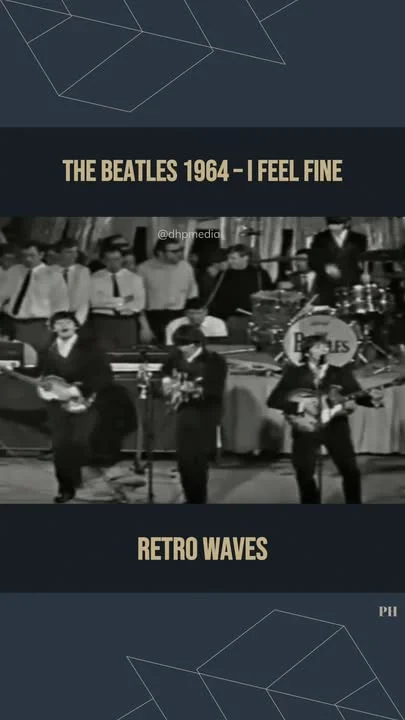
The Beatles had a knack for turning accidents into art. But few moments capture that magic quite like the opening of “I Feel Fine”—a track that begins not with a chord or a beat, but with a sustained, electric howl. That single note of feedback, a sound that engineers once considered a mistake, became the signature of a revolution. It was a fleeting, defiant squeal that rewrote the rules of pop music.
The date was October 18, 1964. Inside Abbey Road’s hallowed Studio Two, the four mop-tops were deep into a grueling nine-hour session. They needed a single to cap off a year of global domination—and they got it, almost by accident. John Lennon had written the song’s core riff while working on another track, “Eight Days a Week.” But the real breakthrough came when a guitar leaning against an amplifier began to vibrate and cry. The studio staff, led by producer George Martin, initially recoiled. Feedback was unprofessional; it was noise that had to be scrubbed.
“Can we have that on the record?” Lennon reportedly asked, recognizing a texture that no one else had yet deemed musical.
That decision turned an unwanted artifact into the song’s opening statement. It was a gamble that paid off in ways far beyond the charts. “I Feel Fine” became the band’s sixth UK number one and their fifth US chart-topper, but its true legacy lies in how it reshaped the studio. The feedback that opens the track wasn’t just a gimmick—it was a conscious blurring of the line between perfection and raw electricity. It paved the way for the sonic violence of The Who, the controlled chaos of Jimi Hendrix, and every band that later treated their instruments as tools of pure sound.
Context: The Final Bow of Mop-Top Mania
The single arrived in November 1964, right at the tail end of what we now call the band’s first frantic act. That year had been a whirlwind: the American breakthrough on The Ed Sullivan Show, the release of their debut film A Hard Day’s Night, and an unbroken string of hits. “I Feel Fine” was meant as a standalone release, not part of the British Beatles for Sale album. It was a statement of unshakable confidence, a musical handshake that said, “We are still here, and we are still pushing.”
Lyrically, the song is simple—almost disposable. “Baby’s good to me, you know / She’s happy as can be, you know / She said so / I’m in love with her and I feel fine.” The words are secondary to the overwhelming sense of joy the track radiates. Lennon and McCartney, still writing together under a single credit, were moving toward more sophisticated structures, but here they proved that a two-minute pop blast could still carry weight.
The Sound of the Drive: Riff, Rhythm, and Raw Energy
After that iconic feedback, the song launches into one of Lennon’s most indelible riffs—a descending arpeggio in D, C, and G major. It churns and pulses, demanding immediate attention. Ringo Starr’s drumming adds a subtle Latin-tinged groove, a double-time hi-hat feel that makes the track dance without losing momentum. Paul McCartney’s bassline locks in, driving the melody forward with the force of a locomotive.
George Harrison’s guitar work is equally notable. He mirrors the main riff during the verses, but his solo section is a masterclass in studio craft. He overdubbed two parts: a rhythm track and a clean, almost country-inspired solo that cuts through the mix with sharp precision. There is no piano or orchestra here—just four men and their instruments, captured at their leanest and most confident. Listening with modern studio headphones, you can hear every breath and string scrape, the raw energy of a band on the cusp of something greater.
Innovation as Accident: The Feedback Legacy
The feedback intro is what elevates this song from a great pop single to a foundational text of rock innovation. Lennon often claimed that The Beatles were the first to intentionally commit feedback to commercial vinyl. Whether it was pure accident or a controlled experiment born from live performance, the decision to keep it was radical. It proved that the studio itself could be an instrument.
“The true lesson of ‘I Feel Fine’ is that sometimes, the greatest leaps in musical innovation are found not in the grand composition, but in the decision to celebrate a sonic mistake.”
That opening note, brief as it is, forces listeners to recalibrate. It prepares the ear for music that feels both familiar and startlingly new. It is a microcosm of the revolution happening inside Abbey Road’s walls—a band working alongside George Martin and his engineers to push beyond the limits of mid-century recording. They showed the world that the four-track tape machine was a playground, not a cage.
Listening Recommendations: Songs of Riff, Rock, and Innovation
- The Kinks – “You Really Got Me” (1964): A similarly foundational guitar riff that defined the sound of 1964 rock.
- The Who – “My Generation” (1965): Raw aggression and feedback-laden energy that echoes the same spirit.
- The Rolling Stones – “Satisfaction” (1965): Built around an instantly recognizable, commanding central riff.
- Chuck Berry – “Roll Over Beethoven” (1956): The blueprint for the three-chord rock energy that directly influenced The Beatles.
- Bobby Parker – “Watch Your Step” (1961): The rhythm and blues track that reportedly inspired Lennon’s signature arpeggiated riff.
- Jimi Hendrix Experience – “Foxy Lady” (1967): A masterclass in using controlled guitar feedback as a core texture.
To listen to “I Feel Fine” today is to hear the foundations of the sonic landscape we now take for granted—from garage rock to noise rock—laid down in a single, defiant note. It is a pure declaration of joy, and a reminder that sometimes the best ideas come from embracing the accident.