
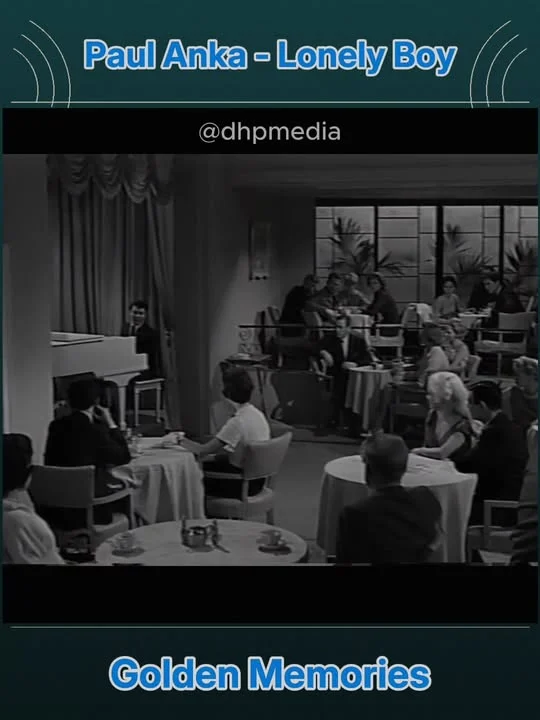
In the twilight of the 1950s, a strange quiet settled over American pop music. The first wild storm of rock and roll had passed, leaving behind a glittering calm. Into this delicate pause stepped a new kind of star the teen idol polished in a tailored suit, vulnerable behind a rehearsed smile. And no song captured the exquisite ache of that moment more perfectly than Paul Anka’s Lonely Boy. It was a confession wrapped in orchestral grandeur, a teen heartbreak narrated by a boy who already owned the world but admitted he had nothing without love.
The year was 1959, though the recording happened months earlier in August 1958. Anka was barely seventeen when he cut the track, still riding the waves of his earlier smash Diana. But where Diana was breathless and frantic a teenager in love Lonely Boy sounded older, wiser, almost mournful. It was the sound of a young man staring at his own reflection and seeing only emptiness. The song was released as a standalone single on ABC-Paramount in May 1959, not tied to any album at the time. Its cultural reach expanded when Anka performed it in the film Girls Town as the character Jimmy Parlow. That move the union of pop record and silver screen locked the song into the public imagination not as mere radio fodder but as a short dramatic scene. It became Anka’s first and only single to reach the summit of the Billboard Hot 100, cementing his reputation as a formidable songwriter in a landscape still dominated by older hands.
The real genius of Lonely Boy lies in its arrangement. The legendary Don Costa took the helm of production, dressing Anka’s simple heartfelt melody in the lavish robes of post big band elegance. The rhythm section is gentle, almost waltz like in its shuffle, but what grabs the ear is the sheer density of the orchestration. High plaintive strings sweep in from the first note, creating an atmosphere of profound melancholy. These are not rock and roll strings they are the strings of a 1950s epic, rich with vibrato and smooth sustain. The tension between Anka’s youthful slightly nasal voice and the sophistication of the backing band is fascinating. He sounds like a kid pleading from the center of a ballroom far too grand for him.
It took the intimacy of a ballad and wrapped it in the scale of a Hollywood overture
Listen to the dynamics of the verses. Anka holds back, his voice perched carefully above a cushion of sound. The bass line is simple and supportive. A brief bright chime from a guitar or the muted punctuation of a piano provides harmonic grounding without ever distracting from the voice. The piano enters with a graceful almost arpeggiated motif in the second verse, a fleeting shimmer that underscores the sentimentality of the lyrics. Then comes the chorus. The full weight of Costa’s arrangement descends. The brass section swells just enough to give the lament gravity and the strings double their intensity, soaring into a near operatic expression of sorrow. The whole thing builds to a controlled catharsis, an emotional architecture rare in pure pop music of the day.
The lyrics lay bare a paradox. Anka sings I got everything a lonely boy could want / But I don’t have you. The teen idol the boy with fame fortune and screaming fans confesses that success means nothing without love. This is the ultimate aspirational tragedy having everything yet still being a lonely boy. The narrative resonated deeply because Anka wrote his own biggest hits. When you listened you were not hearing a song handed down by an older studio writer you were hearing the boy’s own composition. That authenticity made the pathos real. Young fans and even aspiring musicians who bought the sheet music to practice the chords felt a direct connection.
The song endures because its emotional pacing is masterful. A spoken word section a hallmark of the era breaks the formality of the song structure giving the listener a moment of direct one on one confession before plunging back into the lush orchestral wash. It is a masterclass in restraint for all the string swept drama Anka never devolves into shouting or pure rock abandon. He maintains his smooth pleading tone never letting vulnerability become abrasive. The whole effect is a perfect shimmering distillation of post war pre counterculture adolescent angst a gilded cage for a yearning heart.
Today returning to the track with studio headphones reveals the subtle placement of the brass and the warm slightly compressed quality of Anka’s vocal. It is a sound distinctly pre Beatles retaining the warmth of the crooner tradition even while the subject matter points toward the hormonal drama of rock and roll. Lonely Boy is the bridge between Sinatra’s arrangement sensibility and a teenager’s heartache. For those who want to explore this particular moment in pop history several companion pieces capture the same balance of youthful voice and sweeping orchestral drama. Bobby Darin’s Beyond the Sea from 1959 showcases a young dynamic voice backed by cinematic big band swing. Connie Francis’s Where the Boys Are from 1960 shares the melancholy atmosphere and orchestral pop sensibility. Neil Sedaka’s Oh Carol released in the same year balances youthful sentiment with sophisticated production. Frankie Avalon’s Why from 1959 captures the innocent questioning vulnerability that defined the teen idol ballad. Brenda Lee’s I’m Sorry from 1960 features a similar contrast between a youthful voice and a heavy lush string section. And Johnny Mathis’s Chances Are from 1957 offers the velvety vocal tone and traditional impeccably executed pop orchestration focused on pure romance. Together these songs form a soundtrack to a brief shimmering era when pop music dared to treat teenage heartbreak with the seriousness of a Hollywood score. Paul Anka’s Lonely Boy remains its most poignant monument a testament to precocious talent and the transformative power of a top tier orchestral arrangement.