
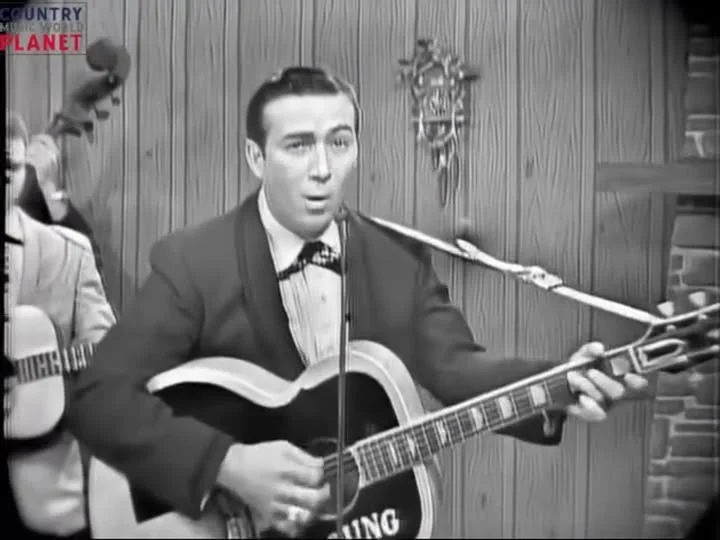
There is a specific kind of solitude that settles in when a door closes for the last time. The silence becomes heavy, animate. It demands a response. This was the claustrophobic heartbeat that Faron Young and Willie Nelson captured in a 1961 recording. They turned an empty room into the most crowded place on earth.
By 1961, Faron Young had built a reputation on honky tonk rowdiness. The nickname Hillbilly Heartthrob suited a man of raucous energy and brash country flash. Then the Nashville Sound began to smooth the rough edges of the genre, and Young found himself at a stylistic crossroads. The result was a piece of music that defied easy category. It topped the country charts for nine weeks. It also marked Young as a crossover force, earning a spot at number 12 on the Billboard Hot 100. This was his only significant pop hit, a validation of its gentle sophistication.
The story behind the song is just as powerful as its sound. A young songwriter named Willie Nelson was struggling to make his voice heard in Nashville. Young chose to record this composition, a gesture that reportedly came with a personal loan for the struggling writer. The single launched a legendary career. It signaled a new literary turn in country songwriting, one built on conversational intimacy. The song was produced by Ken Nelson and Marvin Hughes.
The genius of the recording lies in its restraint. Floyd Lightnin Chance drives a double bass line that moves like a slow, drunken pulse. The piano, played by Marvin Hughes or Floyd Cramer, provides a gently rolling counter melody. Clean electric guitar fills hang in the silence like held breaths. The Wilburn Brothers offer soft, distant harmonies that feel like the echoes of an empty hallway. The entire arrangement is built on deliberate space.
The song is less a song sung and more a confession whispered, turning a room into a psychodrama.
It demands a specific listening environment. To truly feel the intimacy of these elements, the woody thud of the bass and the subtle percussion, one must lean into a pair of studio headphones. Only then does the full claustrophobia of the recorded silence become apparent.
The lyric is not a poem recited from a stage. It is a genuine, desperate conversation. Think of the moment Young turns to the glass. “Well look here, is that a teardrop in the corner of your pane? Now don’t you try to tell me that it is rain.” It is a devastating moment of projection. He has no one left to talk to but the architecture of his own loneliness. The song lives in the negative space. A young guitar student once struggled with this piece. He could play the chords but he could not grasp the rhythm of the emptiness between them. The heartache does not live in the notes. It lives in the time between them.
The impact of this song created an echo through the decade. It stands as a moment when polished production was used not to mask the pain but to perfectly spotlight it. For those wanting to walk the same emotional landscape, the path leads to other masterworks of solitude. Willie Nelson explored this same conversational regret in Funny How Time Slips Away. Patsy Cline brought her profound despair to Crazy. The roots stretch back to Hank Williams speaking to a whip poor will in I’m So Lonesome I Could Cry. George Jones wrestled with heartache in She Thinks I Still Care. Ray Price measured heartbreak in Heartaches By the Number. Jim Reeves delivered a difficult, intimate message in He’ll Have To Go. For a compelling listen of the signature tune, the original track is widely available online.
Hello Walls is a quiet tragedy. It plays out in the only room where the truth can still be spoken. It is not a story told. It is a moment fully inhabited.