
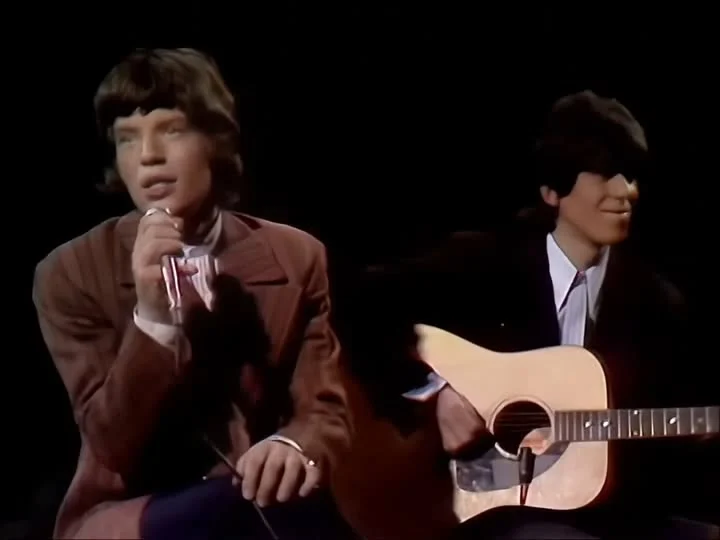
There is a particular sadness in watching children play from a distance. That sadness became one of the most unlikely signatures in the Rolling Stones catalogue. As Tears Go By was one of the earliest original songs written by Mick Jagger and Keith Richards together. The song was placed in the hands of Marianne Faithfull by their manager Andrew Oldham, who had signed her to his management roster. In 1964 the track was slotted onto her debut single as the B-side, but the record company heard something special and flipped it to the A-side. That decision gave Faithfull her first significant hit and changed the course of her life.
The bond between Faithfull and the Stones only deepened with time. In 1966 she entered a turbulent romance with Mick Jagger that lasted for three years. That intense period connected her even more closely to the band’s creative world, and she helped write Sister Morphine while also introducing Jagger to the book that inspired Sympathy For The Devil. The song that first made her famous carried its own hidden history. It was originally titled As Time Goes By, a name changed to prevent confusion with the enduring standard associated with Casablanca.
When the Rolling Stones recorded their own version in 1965, they took an unexpectedly delicate approach. Jagger handled the vocals while Richards played acoustic guitar in the company of a gentle string arrangement. No other members of the band performed on the track. It was a striking departure for a group still leaning heavily on blues covers during live shows. The new song did not fit the rowdy image they were building, but it showed a softer side and proved that the band could deliver heartfelt ballads as well as raw rock and roll.
The release strategy for the song shifted on different sides of the Atlantic. American radio was in the middle of a ballad craze, so the song was pushed out as a single in the United States. In the UK, however, the band held back for six months rather than compete with The Beatles and their monumental hit Yesterday. When As Tears Go By eventually emerged in Britain, it was tucked away as the B-side of 19th Nervous Breakdown.
The song also made television history. When the Stones appeared on The Ed Sullivan Show on February 13 1966, As Tears Go By was one of three songs they performed, alongside (I Can’t Get No) Satisfaction and 19th Nervous Breakdown. That appearance marked the band’s first time in color on a United States broadcast, adding a visual milestone to an already storied career.
For Marianne Faithfull, the song was a quiet launchpad. Her 1964 recording reached number 9 on the UK singles chart and number 22 on the American Hot 100. Those chart positions may appear modest by today’s standards, but they were enough to establish her as a compelling and distinctive voice in the 1960s music scene.
The lasting appeal of As Tears Go By rests in its restrained emotional pull. There is no dramatic chorus and no loud release, only the quiet ache of watching time move forward from the outside. When the narrator sees children singing and remembers doing the same things herself, the tears arrive without explanation and land exactly where they should.
It is the evening of the day
I sit and watch the children play
Smiling faces I can see
But not for me
I sit and watch
As tears go byMy riches can’t buy everything
I want to hear the children sing
All I hear is the sound
Of rain falling on the ground
I sit and watch
As tears go byIt is the evening of the day
I sit and watch the children play
Doin’ things I used to do
They think are new
I sit and watch
As tears go by