
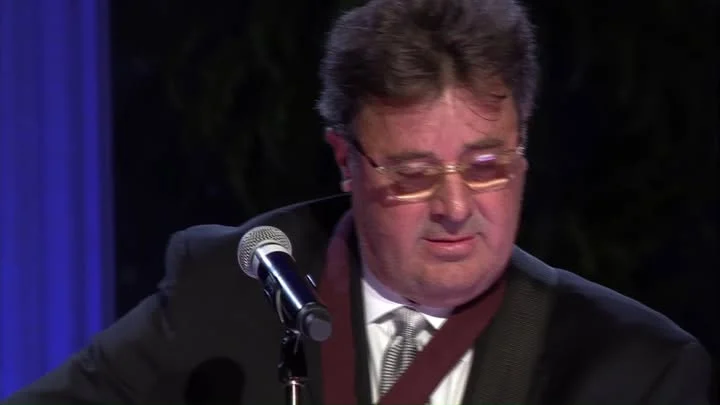
There is a moment in every artist’s life when the music stops being about performance and starts being about confession. For Vince Gill, that moment arrived quietly, not with the roar of a stadium crowd but through the intimate crackle of studio headphones. The Price Of Regret does not announce itself. It seeps into the room like morning light through dusty blinds, carrying with it the weight of a lifetime of unexamined shadows.
This is not the Vince Gill of smoothed-over radio hits or the golden harmonies of Pure Prairie League. This is a man who has earned the right to look backward and found the view unsettling. The year was 2019 when Gill released Okie on UMG Recordings, an album that refused the comfortable path of legacy touring and greatest hits collections. Instead, he chose to dig into the red dirt of his Oklahoma upbringing and pull up roots tangled with things most country songs politely avoid: racial prejudice, inherited shame, the slow poison of unspoken regret.
The song arrives early on the tracklist, almost as a warning. There is no fanfare, no crescendo. Just Gill’s voice, slightly worn at the edges now, rougher than the velvet tone that defined his 90s peak. That texture matters. It gives the lyrics a credibility that polish could never achieve. He sings about blindness not as metaphor but as diagnosis. When he asks listeners to close their eyes and forget the color of skin, the question lands not as sermon but as shared human failure.
The arrangement mirrors the confession. An acoustic guitar picked with surgical precision. Brushed drums that barely disturb the air. A piano that chimes in with single sustained chords like distant church bells heard through fog. The legendary Paul Franklin adds pedal steel, but only in fleeting moments, as if the instrument itself is hesitant to intrude on such vulnerable ground. The rhythm section of Fred Eltringham and Michael Rhodes holds everything in place without ever calling attention to itself.
It’s a mirror-true album, from the perspective of a searcher, not a preacher.
Gill has said the song’s core came from reflecting on his own family’s prejudices and a pivotal encounter with an African American lawyer. That personal origin gives the track its peculiar power. This is not an artist performing empathy from a distance. This is someone who has looked into his own history and found things that cannot be explained away. The lyric operates not as judgment but as invitation. Everyone is broken. Everyone is scarred. Healing waits not in isolation but in the awkward, necessary reach toward another person.
What makes the song remarkable is its refusal to resolve. The dynamics swell slightly, then retreat. The chorus does not explode into catharsis. The pedal steel rises, then falls back, as if the moment of clarity has been pulled away by doubt. That restraint is the song’s deepest insight. Regret is not something we overcome. It is something we learn to carry. Gill sings about paying the price of regret most days, and the honesty of that admission lingers long after the final note fades.
This is music that demands attention of a particular kind. The kind one gives to old photographs found in a attic box. The kind that accompanies a solitary drive through fog, watching headlights cut through uncertainty. It is the soundtrack for those moments when the long slow realization of a mistake finally settles not as thunderclap but as persistent ache. Gill takes personal failure and frames it as collective burden, offering not easy absolution but the dignity of shared sorrow.
The song belongs to a tradition of American songwriting that values truth over polish. It stands alongside the work of Jackson Browne and Kris Kristofferson and Merle Haggard, artists who understood that the great songs are not the ones that make us feel powerful but the ones that make us feel known. In a political climate defined by shouting, this song leans in with a whisper and asks only that we listen long enough to recognize ourselves in its mirror.