
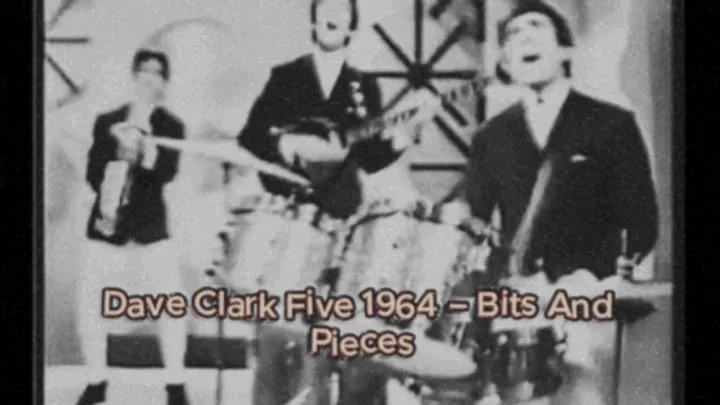
The opening seconds of The Dave Clark Five song Bits and Pieces hit like a sledgehammer wrapped in plywood. A raw, percussive thud repeats four times, not from a traditional drum but from a plank or exercise board stomped on by a band in full fury. That primal sound, captured in 1963 and unleashed worldwide in early 1964, still grabs listeners by the gut. It bypasses the brain and goes straight for the chest, demanding movement before thought.
For a generation raised on polite reverb and crooning harmonies, this track from the Tottenham outfit was a shock to the system. The British Invasion had already begun with the polished charm of Liverpool, but the Dave Clark Five offered something different. They delivered a blunt force sound that producer and drummer Dave Clark himself called the Tottenham Sound. He often worked with engineer Adrian Kerridge under the pseudonym Adrian Clark to achieve a mix that pushed the low end and treble forward, leaving the mids to fend for themselves. The result was a sonic signature as identifiable as a fingerprint.
The arrangement of Bits and Pieces is a lesson in controlled chaos. Mike Smith delivers the lead vocal with frantic breathlessness, singing about a shattered love while the rest of the band shouts the title back in call-and-response. No subtlety, no layered harmonies. Just raw, communal emotion. Smith also handles the organ, a bright Hammond B3 that cuts through the pounding rhythm like a church bell in a construction site. That contrast between sacred tone and earthy percussion gives the track its electric tension. Lenny Davidson’s guitar stays far from fancy solos, instead slashing punchy chords that build a wall of mid-range grit. The piano is virtually absent, a deliberate choice that lets Smith’s keys carry both harmony and melodic urgency.
The drumming itself remains the centerpiece. Dave Clark’s relentless snare work, sometimes doubled in studio by session player Bobby Graham, drives the song forward like a runaway train. The entire track clocks in under two minutes, which only amplifies its kinetic energy. It bursts out, lands its blow, and vanishes before the listener can breathe. That compact structure makes it endlessly replayable. It works as a concentrated dose of adrenaline for a morning workout, a late-night cleaning session, or a moment when pure sonic fuel is needed.
The song is a perfect reminder that sometimes, the most sophisticated emotional impact comes from the most elegantly simple musical sledgehammer.
When Bits and Pieces hit the charts, it climbed to top five positions in both the United Kingdom and the United States. That global success cemented the band’s place alongside the biggest names of the era. The track appeared on the American album Glad All Over, a common strategy for British Invasion acts who tailored their releases for new overseas fans. For the Dave Clark Five, that meant their most potent singles reached a hungry audience quickly.
The legacy of this recording extends far beyond its initial chart run. Listen to it with premium audio gear today and the mix still feels shockingly modern for 1964. The forward placement of the drums, the shout-along chorus, the compressed fury of the whole track. It sounds less like a museum artifact and more like a coiled spring waiting to jump out of the speakers. That visceral quality bridged generations. A teenager skeptical of anything pre grunge heard the opening stomp and instantly understood the power of the track. It bypassed cynicism the same way it bypassed thought.
Credited writers Dave Clark and Mike Smith, with possible input from Ron Ryan, crafted a melody and arrangement that became the band’s permanent signature. The production vision focused on bass and treble extremes, a heavy beat that never wavers, and a refusal to wander into complexity. That approach influenced later movements from glam rock to punk. Drummers who wanted to dominate the mix instead of supporting it saw a template in Clark’s aggressive attack. Guitarists looking for fury over finesse found their blueprint in Davidson’s slash chords.
Bits and Pieces remains a counterpoint to the sophisticated, harmonically rich music that emerged later in the sixties. It is a victory for brute force and economic production. What it lacks in lyrical depth, it makes up for in physical presence. It exists as a relentless call to dance, to move, to feel the pulse in the chest. Decades later, that call has not faded.
Listening Recommendations
For those who want to follow the thread of raw, percussive rock from the same era, several tracks share the same spirit. The Dave Clark Five themselves delivered the immediate predecessor with Glad All Over, which shares the thunderous drum sound and anthemic shouted chorus. The Standells offered Dirty Water in 1966, capturing a similar garage rock urgency. The Kinks released You Really Got Me in 1964, a simple riff driven track that prioritizes sonic impact. The Rolling Stones covered Not Fade Away in 1964, featuring a heavy Bo Diddley pulse. Gerry and the Pacemakers gave How Do You Do It in 1963, with rapid fire energy and bright production. Across the Atlantic, The Kingsmen recorded Louie Louie in 1963, a three chord garage stomper with an insistent rhythmic core.