
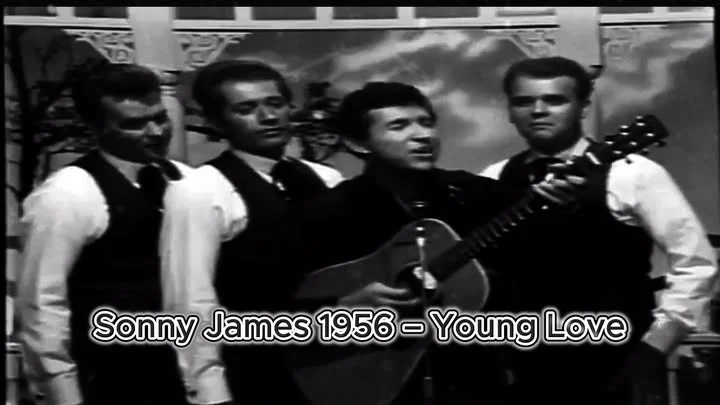
Late at night, in the quiet hum of a car cabin, a couple scrolls through a streaming service and lands on a song that feels like it was made for this exact moment. The decades melt away. What emerges is a sound suspended in amber, a voice so tender it seems to speak directly to the heart. This is the strange power of Sonny James’s 1956 single “Young Love” – a recording that has outlived the genres that tried to bury it and still finds new listeners willing to fall under its spell.
Released on Capitol Records and recorded in Nashville’s Music City Recordings studio, the track was never meant to be an album centerpiece. It arrived as a modest 45 RPM single, a quiet bet placed by producer Ken Nelson. Nelson, a Capitol stalwart with a gift for navigating the tricky border between country honesty and pop polish, took a song originally written by Ric Cartey and Carole Joyner – Joyner supposedly still a high school student at the time – and shaped it into something universal. The gamble paid off in ways no one could have predicted.
“They say for every boy and girl, there’s just one love in this whole world.”
The artist behind this gentle revolution was Jimmie Hugh Loden, an Alabama native who performed as Sonny James. Before “Young Love,” he had been a recording artist in search of his true center, his previous singles only hinting at the “Southern Gentleman” persona he would eventually embody. The song became his breakthrough, a soft-spoken counterpunch to the electric noise of the rock and roll era.
What makes the arrangement so remarkable is its restraint. The track opens not with a roar but with a barely-there heartbeat from Buddy Harman’s drums – a gentle snare tap, a light cymbal wash. Lightning Chance’s bass line provides a warm, subtle swing that leans country rather than rockabilly. Pete Wade’s electric guitar is the lead voice, but it plays with architectural delicacy, offering clean melodic fills that frame James’s vocal without overpowering it. The piano chords are barely audible, a ghost in the background. And then there is James’s voice itself: a tenor of remarkable clarity, delivered with a devotional sincerity that never strains or shouts. He tells a story of uncomplicated first love, and he makes it feel like the most important thing in the world.
The secret weapon, however, is the background vocal arrangement. The hushed harmonies of either The Jordanaires or a similarly styled group like The Eligibles swell behind James on the chorus, adding a creamy, gospel-tinged counterpoint. This blend of clean country instrumentation and pop-friendly vocal sweetness created the signature “Nashville Sound” that would define country music for years to come. It made the record palatable to a national audience hungry for simple, melodic tunes in a decade growing increasingly complicated.
When “Young Love” hit the charts in early 1957, it achieved something historic. It reached number one on the country charts while also climbing near the very top of the Billboard Hot 100’s immediate predecessor. This dual success established Sonny James as a crossover king and proved that a song rooted in country’s emotional sincerity could connect with the broader youth-driven pop market – provided the presentation was smooth and radio-ready. It opened a pathway for artists like Jim Reeves, Ferlin Husky, and Marty Robbins, all of whom would follow the blueprint James and Nelson had drawn.
“There is a quiet assertiveness in James’s performance, a belief in the simple truth of the lyrics that elevates the entire piece from mere teen ballad to genuine emotional statement.”
Listen closely with a good pair of studio headphones, and you can hear the recording’s era in its warmth. The midrange feels intimate, the natural reverb gives the vocal a live, close-miked immediacy. There is a slight bleed between instruments – a sign of real performances captured in a single room. It feels sincere, not sterile. In a culture increasingly defined by fast cars and loud guitars, “Young Love” offered a moment of tender vulnerability. It is the soundtrack to a slow dance in a high school gymnasium, not a riot in a town square. That quality is why it endures. Everyone understands the emotional state of being utterly, simply, young and in love.
Here are five recordings that share the same mood, arrangement, or era – perfect for listeners who want to go deeper into this golden moment of crossover country.
- Tab Hunter – “Young Love” (1957): The pop contemporary hit version, featuring a smoother Hollywood vocal polish over a nearly identical arrangement.
- Jim Reeves – “Four Walls” (1957): A landmark of the Nashville Sound, employing orchestral smoothness and emotional restraint.
- Ferlin Husky – “Gone” (1957): A crossover hit with lush, sophisticated vocal delivery that broadened country’s appeal.
- Marty Robbins – “A White Sport Coat (and a Pink Carnation)” (1957): Shares the theme of youthful formal romance and the signature smooth production of Capitol and Columbia.
- Elvis Presley – “Love Me Tender” (1956): A direct predecessor demonstrating the power of a subdued, sincere ballad in the explosive rock and roll landscape.