
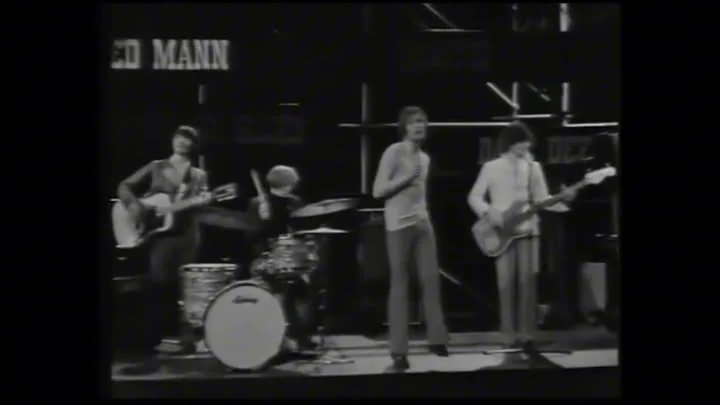
There is a moment when a song stops being just a recording and becomes a doorway to pure, uncomplicated joy. For Manfred Mann’s “Mighty Quinn,” that moment arrives within the first three seconds, courtesy of a flute line that seems to skip and dance like sunlight on water.
It is early 1968. The world is coiled tight with war, protest, and the long hangover of psychedelia. Yet here comes a whimsical little record about an Eskimo who brings cheer to a despairing world and somehow, against all odds, it becomes a global number one hit. How did a cryptic Bob Dylan basement tape get transformed into one of the most irresistibly happy pop songs of the decade? The answer lies in the genius of interpretation, a skill that Manfred Mann had honed to an art form.
The band had long been the premier translators of Dylan’s dense poetry into accessible pop gold. They had already scored with “If You Gotta Go, Go Now” and “Just Like a Woman.” So when Dylan’s manager sent over rough acetates from the 1967 Woodstock sessions, the band’s singer Mike d’Abo faced a peculiar challenge. He later described the process as learning a song phonetically in a foreign language. He had to decipher the mumbled, freewheeling verses and impose a structure that would let the melody breathe. That act of translation was the first miracle.
The second miracle was the arrangement. From the opening beat, the song is anchored by a jaunty, almost calypso bass and drum groove played by Klaus Voormann and Mike Hugg. But the true stroke of genius is Voormann’s flute. He picks up the instrument and plays a bright, curling counter melody that transforms the entire mood. It is a whimsical, childlike sound that perfectly captures the nursery rhyme quality of the lyrics. Combined with Manfred Mann‘s punchy piano chords and Tom McGuinness‘s restrained guitar accents, the track becomes a masterclass in layered simplicity. Every part serves the song. Nothing competes. Everything drives toward the central joyful pulse.
The single was rush released in January 1968 on the Fontana label. It shot to the top of the UK charts, a massive success that came late in the band’s trajectory. The original album, titled Mighty Garvey! in the UK and The Mighty Quinn in the US, did not chart, highlighting the tension between the band’s hitmaking instinct and their deeper experimental ambitions. But for one shining moment, everything aligned. The commercial imperative and the artistic impulse met in perfect harmony.
What makes the song endure is the way it balances the enigmatic with the ecstatic. Who is Quinn? He might be actor Anthony Quinn, or a sheriff, or simply a character from Dylan’s imagination. The lyric “Everybody’s in despair, every town and everywhere” sets a grim stage, but then the chorus explodes into a shout along celebration. Mike d’Abo delivers the lines with earnest conviction, selling the fairy tale completely. The backing harmonies swell, and for 168 seconds, the listener believes that this mighty figure is coming to solve everything.
Listen on quality premium audio equipment and the careful layering reveals itself. The flute darts in and out of the vocal line like a friendly spirit. The piano comps with bright insistence. The entire texture is both baroque and immediate, polished enough for television but raw enough to feel honest. It is a song that compels movement. It demands a smile. It offers escape from the grey midday grind, a tiny vacation into a world where sleep is the only dream and Quinn brings the goods to every station.
To understand the full achievement, it helps to pair this record with other gems of the era. Consider The Byrds version of Mr. Tambourine Man, another successful chart topper born from a dense Dylan folk song. Or listen to The Tremeloes with Silence Is Golden, which similarly elevates a lesser known B side through brilliant arrangement. The Kinks Waterloo Sunset shares the baroque pop texture and narrative charm, though with a melancholic English focus. The Beach Boys God Only Knows exhibits the same sophisticated harmony work within a pop framework. Traffic Hole in My Shoe matches the whimsical flute driven psychedelic mood. And The Turtles Happy Together possesses the same high energy sing along chorus dynamic that defined the era.
It is a sonic leap that remains fascinating to dissect, a perfect example of what a brilliant cover version can accomplish.
The enduring mystery of “Mighty Quinn” is that we do not need to solve it. The music does not require intellectual analysis. It requires only that we let the flute line carry us, that we join the chorus, that we believe, if only for a moment, that a mighty figure will arrive and make everything right. That is the power of a truly great pop song. It does not answer the big questions. It simply makes them feel irrelevant.