
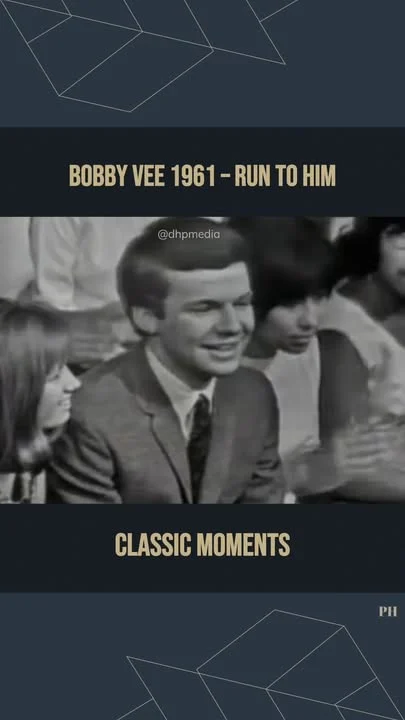
There is a moment in Bobby Vee’s 1961 masterpiece where the orchestra swells, the backing voices rise like a cathedral choir, and a single, heartbreaking instruction is delivered: “Run to him.” It is not a plea. It is not a demand. It is the sound of a young man granting permission for his own heartbreak, a dignified surrender wrapped in a three-minute pop symphony. That moment—the climax of “Run To Him”—remains one of the most exquisitely painful highs of the pre-Beatles era, a testament to how polished teen idol music could still ache with genuine emotion.
The song arrived at a peculiar crossroads in popular music. The wild, rebellious energy of early rock and roll had been tempered. A new kind of star was emerging, clean‑cut and earnest, led by a parade of Bobbys and Frankies. Bobby Vee was among the most gifted of them. His story itself reads like a pop fairy tale: he stepped in to fill the void left by Buddy Holly’s tragic death, and within two years, he had topped the charts with “Take Good Care of My Baby.” That success set the stage for an even more sophisticated follow‑up. In late 1961, Liberty Records released “Run To Him,” a single that would later anchor the 1962 album of the same name. It captured Vee at his commercial and artistic peak.
Behind the scenes, the song was a collaboration of Brill Building brilliance. Producer Snuff Garrett had developed a signature sound: controlled, cinematic, and deeply melodic. Paired with the songwriting team of Gerry Goffin and Jack Keller, Garrett created a track that feels less like a pop record and more like a miniature tragedy. The recording session, likely at United Western Recorders in Hollywood, was a masterclass in arrangement. Drummer Earl Palmer laid down an insistent, restrained beat that gives the song a forward push without ever letting it rush into chaos. The piano, instead of taking a solo role, provides a warm, sustained harmonic bed. Then come the strings—not as an afterthought, but as the emotional backbone. They sweep and swell, echoing the sorrow that Vee’s voice refuses to dramatize.
The song is a perfectly realized drama of dignified defeat, orchestrated with an intimacy that belies its chart ambition.
Vee’s vocal performance is the soul of the piece. His voice, naturally high and pure, carries no hint of swagger. This is the nice guy who loses, but accepts his loss with weary nobility. The lyrics, deceptively simple, capture teenage angst with surgical precision. The singer acknowledges that his girl has “found another guy who satisfies you more than I do.” Instead of fighting, he instructs her to go. The backing vocals of the Johnny Mann Singers turn that instruction into a sweeping, almost operatic chorus, amplifying the singer’s loneliness until it becomes universal. The final echo—a lingering, high‑pitched “run to him”—leaves a chill that lasts well beyond the song’s fade.
What makes “Run To Him” so enduring is the subtlety of its rhythm section. The guitar work is minimal, confined to clean arpeggios that never steal the spotlight. The bass line is fluid yet steady, grounding the arrangement as it climbs toward its emotional peak. The overall texture is soft, warm, and enveloping—perfect for a dedicated listening room where the nuances of reverb and orchestral overdubs reveal themselves. This is not a song about fighting for love. It is about recognizing the futility of the fight and offering a self‑sacrificing blessing. It cemented Vee’s identity as the sensitive boy next door, a dependable presence on the charts at the precise moment before the British Invasion changed everything.
The track became a transatlantic hit, reaching the Top 5 in the United States and the Top 10 in the United Kingdom. It validated the Brill Building formula and proved that teenage audiences were ready for high‑gloss heartbreak. Even older, more critical listeners could admire the craft—the string arrangement, the vocal blend, the restrained dynamics—even as they dismissed the subject matter as adolescent. “Run To Him” stands as the high‑water mark of the pre‑Beatles teen idol, built not on looks alone but on truly great songs.
For anyone exploring this era for the first time, the song offers a crucial lesson. The early 1960s, often reduced to “bubblegum simplicity,” produced emotionally complex music. “Run To Him” is a piece of music that transcends its moment. Its theme—watching a love move on and choosing to step aside—is timeless. That is why it still resonates today, a perfectly crafted drama of graceful defeat.
Listening Recommendations: Adjacent Moods and Arrangements
Gene Pitney – “Town Without Pity” (1961): Shares the same dramatic, orchestrated sweep and sense of youthful emotional weight.
Del Shannon – “Hats Off to Larry” (1961): Another early 60s hit about a dignified, if slightly bitter, romantic surrender.
The Teddy Bears – “To Know Him Is to Love Him” (1958): Features a similar yearning, high‑register vocal and a restrained, almost reverent mood.
Dion – “The Wanderer” (1961): A perfect contrast, showcasing the rougher, less orchestrated side of the contemporary male vocal hit.
Ricky Nelson – “Travelin’ Man” (1961): An excellent example of another teen idol, with a slightly more laid‑back, country‑inflected approach.
Johnny Mathis – “Misty” (1959): For those seeking the full, lush sound of the string‑heavy pop ballad that underpinned this production style.