
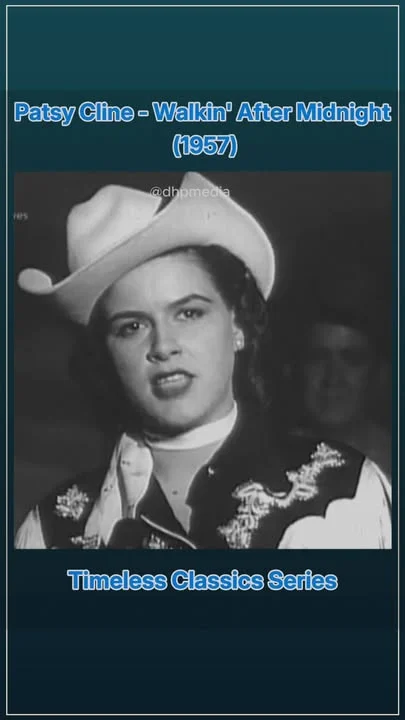
There is a moment, frozen in time on a 1957 television stage, when the voice of a young woman from Virginia stopped a nation cold. Patsy Cline, having just stepped onto the set of Arthur Godfrey’s Talent Scouts, was about to deliver a performance that would rewrite the rules of country music. With a smoky, soulful depth that felt both raw and refined, she poured her heart into a song she had initially resisted. That night, “Walkin’ After Midnight” was no longer just a tune on a page. It became a confession, a declaration, and a hauntingly beautiful portrait of resilience. The audience, spellbound, didn’t just listen. They felt it.
It was a song born from unlikely beginnings. When songwriters Alan Block and Donn Hecht brought “Walkin’ After Midnight” to Cline’s label, 4 Star Records, she was deep in the honky-tonk sound of the era. This song felt different, a curious blend of country, pop, blues, and even jazz that defied easy categorization. Cline was reportedly hesitant, unsure if this hybrid style fit her. Yet, once she stepped into the recording booth, something magical happened. She didn’t just sing the song. She inhabited it. Her voice, rich and warm, transformed the tune into a bridge between genres, a signature move that would define her career and eventually shatter barriers for women in music.
The true power of “Walkin’ After Midnight,” however, lies in its narrative of quiet strength. The lyrics tell a story of a woman wandering under the moonlight, searching for a love that seems just out of reach. But this is no tale of passive heartbreak. The narrator is active, walking miles along the highway, refusing to let sorrow keep her still.
“I go out walkin’ after midnight / Out in the moonlight, just like we used to do / I’m always walkin’ after midnight / Searchin’ for you.”
This is a song about taking control of your own grief, facing it head-on with a stubborn hope. Cline’s delivery, balancing vulnerability with a near-defiant edge, turns a simple love lament into an anthem of human endurance.
Vocalists like Reba McEntire and Kelly Clarkson have since covered the classic, but Cline’s original remains untouchable. Her phrasing was impeccable, her control absolute. When she sang of a “weepin’ willow” crying on his pillow, her voice ached with the weight of shared loneliness. It was this ability to convey pain without bitterness, and longing without self-pity, that made her a crossover sensation. The song climbed to No. 2 on the country charts and cracked the Billboard Hot 100, a rare feat for a female country artist at the time. It was a precursor to her later triumphs like “Crazy” and “I Fall to Pieces,” but it was here, in the starlight of that early success, that her legend began to crystallize.
Today, “Walkin’ After Midnight” stands as more than a classic. It is a testament to the quiet beauty of persistence. Cline’s legacy is not just in the notes she sang, but in the doors she kicked open for generations of female artists who followed. Her story is one of refusing to be confined, of wandering through the lonely hours but never losing sight of the horizon. When we listen to her voice, we are reminded that even in our deepest solitude, there is a shimmer of hope. There is strength in the search. And there is timeless art in the simple act of walking forward, one step at a time, under the moonlight.