
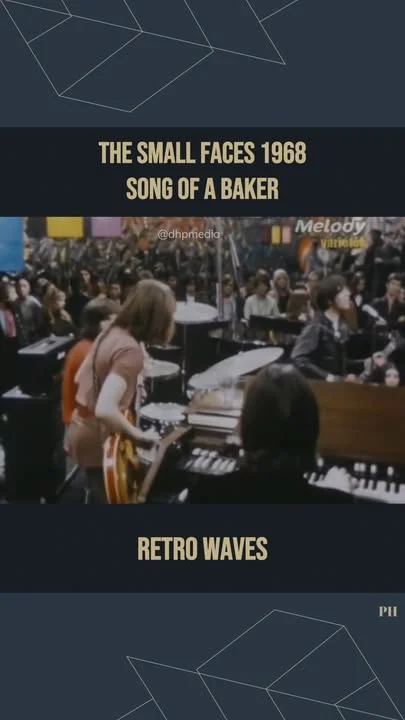
There is a moment on Ogdens’ Nut Gone Flake when the psychedelic swirl settles and the noise fades into something almost sacred. It arrives not with Steve Marriott’s familiar blistering howl but with Ronnie Lane’s gentle voice. In 1968 the Small Faces were at their creative peak inside a London studio, and they had just written a song that would become the quiet heart of their masterpiece on Andrew Loog Oldham’s Immediate label. That song is “Song Of A Baker.”
It is the sound of an artist finding his equilibrium in the simple mechanics of existence, a gentle reminder that even in the greatest storm of creativity, there is peace in the soil.
The Small Faces had long defined themselves with sharply tailored Mod energy and maximum R&B grit. Marriott’s searing soulful vocals and blues-derived guitar work drove their most frantic hits. But on the first side of their ambitious concept album, between the orchestral “Rene” and the Cockney stomp of “Lazy Sunday,” this track sits as a beautiful anomaly. It belongs to Ronnie Lane the bassist and co-songwriter who steps forward for lead vocals on his own composition co-credited to Marriott. His delivery is unhurried warm and deeply earthy. The song reportedly took inspiration from a book of Sufi wisdom and concerns itself not with teenage angst or chart positions but with the cyclical nature of life and the humble process of turning grain into bread.
What makes this piece truly brilliant is its arrangement. Unlike the dense sonic tapestries and phased drums of their biggest psychedelic tracks “Song Of A Baker” remains spare yet rich in texture. Kenney Jones opens with a simple steady drumbeat almost tribal in its heartbeat rhythm. Then Ian McLagan enters on piano with a warm rolling arpeggio that grounds the entire affair in a gentle almost medieval folk-rock sensibility. This is not a trip through a park but a walk across a village green at sunrise. The rhythm section of Lane on bass and Jones on drums drives the song with quiet authority. Lane’s bass line is a constant undulating current less a supportive anchor and more a graceful winding counter melody to his own vocal. For anyone who values a perfectly mixed deeply felt rhythmic performance the tones here are full round and clear suggesting a focus on fundamental elements without excessive studio trickery.
McLagan’s role becomes critical. While his organ work defined the band’s psychedelic phase here he weaves complex patterns on the piano. Cascading phrases emerge at once formal and free giving the song both structure and expansion. Later Steve Marriott enters with a brief soaring guitar solo executed with his signature blend of blues grit and melodic precision. It is a flash of electric lightning across a calm grey sky. The mood remains introspective even spiritual. Lane’s voice is gentle slightly nasal utterly sincere as he sings of bread being made seed being sown and light that shines on everything the same. In the chaos of late 60s psychedelia this track offers a moment of restorative clarity. It is an act of restraint that paradoxically makes it one of the most powerful songs on the album.
Its inclusion on an album titled Ogdens’ Nut Gone Flake with its whimsical concept about Happiness Stan searching for the missing half of the moon is no accident. The song serves as a necessary anchor connecting high flying fantasy back to earth. It is the wisdom gleaned after the journey the quiet revelation that the world’s truth is often baked into the most fundamental acts. For anyone studying how to understand the melodic brilliance of the era the counterpoint between Marriott’s searing line and Lane’s grounded bass on this track offers a masterclass in complementary arrangement.
The Small Faces burned brightly and briefly their creative dissolution hastened by their own intensity. Yet in this track there is a sense of calm inevitability a forward motion powered by a gentle internal light. Beneath the surface of Mod clothes and psychedelic excess there was a deep folk rooted poetry in the songwriting of Ronnie Lane. This song is the seed from which his later solo work grew. It remains a poignant testament to the band’s collective talent and a perfect soundtrack for those micro moments of modern life when the pace finally slows. Imagine driving on an empty motorway at 4 AM or sitting in a quiet kitchen as the first coffee brews “Song Of A Baker” finds the profound in the mundane.