
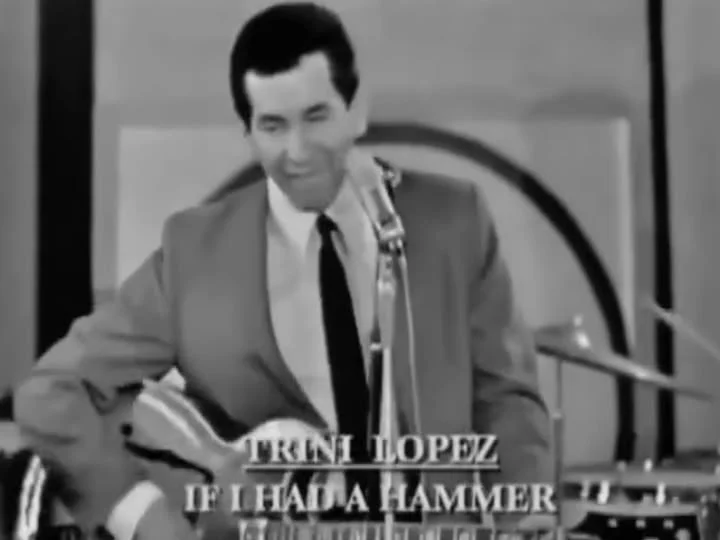
The first thing that hits you is the sweat. Not literal sweat, but the audible presence of it, the humidity of two hundred bodies packed into a Sunset Strip cellar, roaring in the dark. And over that roar, a voice. A Gibson guitar cuts through like a switchblade, and Trini Lopez starts hammering on the strings with the force of a man possessed. This is not a concert. This is a revival. This is 1963, and a 26-year-old Texan is rewriting the rules of live performance in real time.
Forget everything you know about polished studio recordings. This night, captured for posterity on a debut album for a brand-new label, is pure combustion. Lopez walked into PJ’s, a smoky West Hollywood club, with the weight of a legendary producer’s expectations and the golden ears of Frank Sinatra’s team listening from the shadows. The mission was simple. Capture the lightning. Bottle the noise. Sell the frenzy.
And what a frenzy it was. The setlist opener, a radical reinterpretation of a Pete Seeger and Lee Hays folk standard called “If I Had A Hammer,” exploded the room. Where the original was a solemn, acoustic call for justice, this version was a hurricane. The recording captures every shard of feedback, every clink of a glass, every ecstatic scream from the audience. It is a document of a community losing its collective mind, and it is glorious.
The Star-Maker’s Gamble
Behind this gamble was Don Costa, a record producer with a Midas touch. It was Costa who convinced the legendary Frank Sinatra to sign Lopez to his fledgling Reprise label. Sinatra apparently needed little convincing. But Costa made a critical choice. He understood that Lopez was a phenomenon best captured raw. The sterile confines of a studio would have neutered the performance. The only way to capture the magic was to let the tape roll in the middle of the chaos.
Lopez was a vibrant, charismatic force, a Mexican-American kid from Dallas who had been grinding through the club circuit for years. By 1963, he was ready. And PJ’s was his proving ground.
Anatomy of a Reinvention
The genius of Lopez’s version of “If I Had A Hammer” lies in its brilliant deconstruction. The song, written in 1949 as an anthem for labor movements, had been stripped of its serious, church-like reverence and rebuilt as a kinetic dance number. The arrangement was credited to the tight trio that backed him, and it operates like a precision-tuned engine. Lopez’s guitar work is a masterclass in rhythmic attack. He uses flamenco-style percussive strumming, a technique that makes the instrument sound like both a drum and a lead voice at once.
The bass is a relentless, walking beast that never lets up. The drums are recorded with a sharp, dry crack, giving the whole track a tight, almost claustrophobic punch. There are no strings, no horns, no piano. Just raw, unadulterated instrumentation. That emptiness is the key. It creates space for the crowd, and the crowd becomes a fifth instrument. They are not passive listeners. They are participants in a dialogue, shouting, clapping, and singing along at the top of their lungs.
Lopez understood the dynamics of a live show perfectly. He knew when to pull back to a whisper and when to let the room explode. The middle of the song is a testament to this control, a low-slung groove that builds anticipation before the final chorus erupts.
The magic isn’t in what they added to the song, but in what they stripped away, leaving only pure, infectious rhythm.
The Crossover Earthquake
When the single was released, it shattered the boundaries of the American musical landscape. Peter, Paul and Mary had taken the song to the top of the folk charts a year earlier with a reverent acoustic arrangement. But Lopez’s version blew the doors off. It was a fusion that had never been heard on such a grand scale. This was a Mexican-American artist blending Latin rhythms, rock and roll energy, and a folk message into a seamless hybrid. It was a number three hit on the Billboard Hot 100, sold over a million copies, and turned Lopez into a global icon overnight.
The impact was seismic. It demonstrated that the American folk revival could live on the dance floor, that rock and roll could carry a political message without losing its edge. Lopez became a symbol of a new, hyphenated American identity, an artist who proudly wore his heritage while appealing to a universal audience. The live album, his debut, remains a snapshot of this cultural collision, a time capsule of a night when the 1960s truly began to swing.
Scenes from the Afterlife of a Song
Decades later, the song still has the power to unite a room. I recall a wedding reception in the early 1990s, a modest hall filled with relatives from three generations, some of whom had spent the night glued to their seats. The band, aging veterans of a thousand lounge gigs, launched into the opening riff of “If I Had A Hammer.” The effect was instantaneous. It was as if an electric current ran through the floorboards. People who had never spoken to each other suddenly locked arms and began to sing, their faces flushed with joy. They were not singing about social justice. They were singing about togetherness.
The same magic happens on a car radio on a Monday morning. Trapped in a river of brake lights, the song flickers on. The bassline starts thumping. The guitar starts strumming. A transformation occurs. The grumpy driver in the next lane is suddenly tapping his steering wheel. The woman in the SUV ahead is mouthing the words. For three minutes, the misery of the commute evaporates, replaced by a defiant, rhythmic optimism.
This is the true legacy of Trini Lopez. He took a protest song and turned it into a communal celebration, a musical key that unlocks the shared joy in any room. His version of the song is not a cover. It is a reinvention, a blueprint for how to make art that feels both urgent and eternal.
Further Listening
Sam Cooke – “Twistin’ the Night Away” captures a similar blend of smooth vocals and an irresistible rhythmic pulse.
Chubby Checker – “Let’s Twist Again” shares the same dance-craze DNA and early sixties exuberance.
The Champs – “Tequila” delivers a tight, horn-fueled instrumental with a Latin rock undercurrent.
Ritchie Valens – “La Bamba” is the essential companion piece, a Spanish-language rock and roll milestone.
The full live performance, available on YouTube under the title “Trini Lopez – Live At PJ’s (1963) [Complete LP],” remains a time machine for anyone lucky enough to press play.
The needle lifts. The hiss fades. But the electricity never dies. In the history of live music, there are nights that are simply captured on tape, and then there are nights that define a generation. Trini Lopez at PJ’s was the latter. It still is. Just turn it up.