
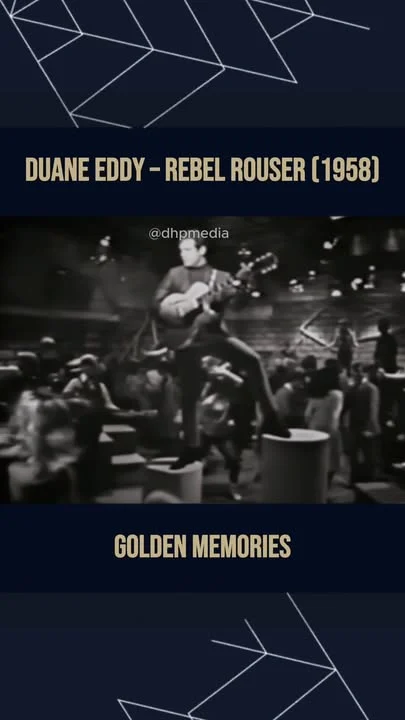
The Sound That Shook the Desert
The desert highway stretches toward a bruise-colored horizon, wind whipping through an open convertible as the scent of creosote and gasoline fills the air. The radio dial lands on a frequency that feels like it has been waiting for this exact moment. Then it happens. A guitar growls from the speakers, low and feral, wrapped in reverb so vast it sounds like a canyon learning to speak. No words are needed and none are wanted. This is pure American attitude, distilled into two and a half minutes of twang.
That sound belonged to Duane Eddy, a guitarist from Phoenix who released a single called Rebel-Rouser in May 1958 on the Jamie label. It stormed to number six on the Billboard Hot 100 and introduced the world to a new kind of guitar hero, one who understood that the silence between notes could carry as much weight as the notes themselves. The track would go on to set the tone for nearly every instrumental rock song that followed.
The recording came together at Audio Recorders studio in Phoenix, where Eddy had joined forces with the visionary producer and songwriter Lee Hazlewood. With fellow producer Lester Sill by their side, they chased a sound that felt enormous, cinematic, and unmistakably American. The composition, co-written by Eddy and Hazlewood, was built on a twelve-bar blues progression that felt both familiar and dangerously new.
At the center of the magic was Eddy’s 1957 Gretsch 6120, played through a heavily modified Magnatone amplifier. The secret lay in his decision to pick out melodies on the instrument’s bass strings, creating a dark and booming timbre that became his signature. This was no polite jazz or country accompaniment. This was a lead instrument designed to command attention. Eddy later recalled the cavernous acoustic space that gave the reverb its majestic depth, describing it as an empty 2,000-gallon water tank singing along with him.
In the studio, Eddy was backed by a tight rhythm section featuring Buddy Wheeler on electric click bass, Jimmy Simmons on acoustic bass, and Bob Taylor on drums. Al Casey added piano while Donnie Owens and Corki Casey O’Dell handled rhythm guitar. Together they laid down a fundamental track crackling with raw energy. But the song truly exploded during a later session in Los Angeles, where a series of inspired overdubs transformed it into a chart-topping phenomenon.
“The tone of Duane Eddy’s guitar on ‘Rebel-Rouser’ is not merely a technical effect,” one critic observed. “It is the sonic blueprint for every leather jacket, every drag race, and every whispered dare of the late 1950s.”
Those Hollywood sessions brought Gil Bernal‘s swaggering tenor saxophone into the arrangement, trading licks with Eddy’s guitar like two old friends finishing each other’s sentences. The doo-wop group The Sharps, who would later find fame as The Rivingtons, added rebel yells and handclaps that burst through the mix with unbridled enthusiasm. It was not just a backing vocal track. It was a sonic grenade, adding a layer of human excitement that elevated the record from a masterful instrumental study to an unassailable cultural marker.
The arrangement employed a brilliant device known as step modulation. Every time the main theme returned, the key climbed a half-step, from E to F to F-sharp to G. This chromatic ascent created a physical sensation of acceleration, a musical jolt that kept listeners riveted even after countless replays. It was a trick so effective that it has been replicated endlessly ever since, but in 1958 it felt utterly fresh.
At the time of its release, Rebel-Rouser was a standalone single, not pulled from an album. It later anchored Eddy’s 1958 debut LP, the memorably titled Have ‘Twangy’ Guitar Will Travel, which solidified his status as the King of Twang. The record became a milestone in instrumental rock history and a testament to the power of simple harmonic ideas paired with a revolutionary sound.
The song’s cultural footprint has only grown with time. Its unmistakable opening notes have soundtracked iconic moments in films like Forrest Gump and The Sandlot, instantly conjuring images of rebellion, freedom, and the open road. Even today, the raw and clear fidelity of the recording makes a strong case for investing in premium audio equipment to appreciate the true depth of the reverb and the distinct attack of the string-bending. This is music that demands to be felt as much as heard, a primal force that never truly receded.
For listeners discovering Eddy’s work for the first time, or for those returning with fresh ears, the journey does not have to end here. A rich vein of instrumental rock awaits anyone willing to follow the twang.
Riding the Twang Wave
Link Wray & His Ray Men – “Rumble” (1958). The rawest and most dangerous guitar tone ever committed to tape, paving the way for Eddy’s success.
The Ventures – “Walk, Don’t Run” (1960). A masterclass in how Eddy’s twang helped shape the surf rock revolution.
The Shadows – “Apache” (1960). The Eddy sound filtered through a British lens, all epic reverb and brooding atmosphere.
Booker T. & The M.G.’s – “Green Onions” (1962). A foundational instrumental built on an iconic guitar riff, with a prominent organ stepping in where the piano might have been.
Dick Dale – “Misirlou” (1962). Dramatic reverb and a huge, defining guitar sound create a cinematic and thrilling atmosphere.
The sound of a desert highway. The thrill of a dare. The weight of a leather jacket. Duane Eddy captured all of it and more, proving that sometimes the loudest statement requires no lyrics at all.