
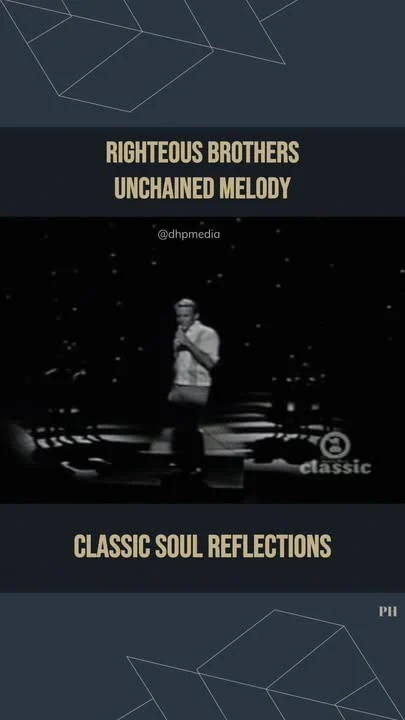
Some songs don’t just get played. They get felt. They find a way under your skin, settle into your memory, and stay there for decades. “Unchained Melody” by The Righteous Brothers is one of those rarities. A track that, even after all these years, still has the power to stop a room cold. It’s a masterclass in emotional delivery, a delicate balance of sound and silence, and a testament to what happens when raw talent meets perfect timing.
Much of that magic can be traced back to its origins on the 1965 album Just Once in My Life. At first glance, you wouldn’t think this was the record’s destined centerpiece. The album, produced by the legendary Phil Spector, leaned heavily into his famous “Wall of Sound”—a densely layered, almost overwhelming production style that defined many hits of the era. But right in the middle of that big, booming soundscape sat a song that did the exact opposite. It pulled everything back. It whispered. It waited. And in doing so, it changed everything.
What’s remarkable about the album is how it showcased the duo’s range. Bill Medley and Bobby Hatfield could swing from soulful grit to pop polish without missing a beat. But it’s Hatfield who truly steps into the spotlight here. His lead vocal on “Unchained Melody” is less a performance and more a confession. From the first line, he sounds like someone holding back tears, and that vulnerability is exactly what makes it so compelling.
The Sound of Restraint
Instrumentally, the song is a lesson in moderation. It opens on a sparse, contemplative piano line that feels almost private, like you’ve stumbled into a late-night rehearsal. There’s no rush, no flash. Just a melody that breathes. Then comes the soft shimmer of a guitar, subtle and warm, weaving itself around the keys. The strings enter gently, not to overpower, but to lift. By the time the orchestra swells toward the final climax, the emotion hits like a wave—only to recede as quietly as it came.
That push-and-pull is the song’s genius. In an era when louder often meant better, “Unchained Melody” proved that holding back could be just as powerful, if not more. The arrangement gives the voice room to roam, and Hatfield uses that space with total command. His control is astonishing. He moves from a near-whisper to a soaring, heart-stopping high note with an effortlessness that feels almost supernatural. It’s no exaggeration to call it one of the greatest vocal performances ever captured on tape.
“It’s less a performance and more a confession.”
Why It Still Cuts Deep
The song’s legacy is as vast as its emotional range. Covered by everyone from Elvis Presley to LeAnn Rimes and beyond, no version has ever quite matched the ache of the original. A good part of that is timing. When “Ghost” hit theaters in 1990, the song found a brand-new audience. That iconic pottery scene, set to the track’s swelling crescendo, reignited its popularity and introduced it to a generation that wasn’t even alive when it was first released.
But the song’s staying power has less to do with movie moments and more to do with its themes. Love, longing, separation, hope—these aren’t fleeting emotions. They’re universal. They’re what we carry with us through every stage of life, regardless of age or background. That’s why the song shows up at weddings, anniversaries, and quiet evenings when someone just needs to feel something real. It holds space for both joy and sorrow, sometimes in the same breath, and that duality is rare.
If You Love This Song, Try These
For those who want to chase that same ache, there are a few tracks that share its soulfulness and depth
“Can’t Help Falling in Love” by Elvis Presley is a natural pairing. Its gentle melody and tender devotion echo the same kind of timeless romance. “Bridge Over Troubled Water” by Simon & Garfunkel offers a similar sense of emotional openness, built on piano and soaring harmonies. “Something” by The Beatles brings an intimacy that feels almost private, and “I Will Always Love You” by Whitney Houston matches the intensity with breathtaking vocal power. And for something more poetic, “Hallelujah” by Leonard Cohen or Jeff Buckley lingers long after the final chord fades.
More Than a Song
“Unchained Melody” is one of those rare pieces of music that feels less like a track and more like a memory. It’s rooted in a specific time and place, yet it’s impossible to pin down to any one era. It belongs to everyone. It belongs to no one. From its quiet beginnings on Just Once in My Life to its place in pop culture history, it has become a touchstone for what music can do when it’s honest.
So whether you’re revisiting it for the hundredth time or hearing it for the first, let it wash over you. Listen to the way the piano breathes. Feel the strings rise around Hatfield’s voice. Let the lyrics land where they will—no matter what you’re feeling, the song already knows.